
military conflicts
controversial
impactful

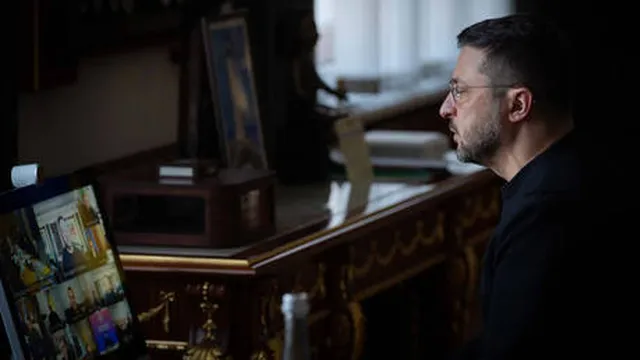
Zelensky blames West for critical military supply issues

Jan 30, 2026, 12:14 PM10
(Update: Jan 30, 2026, 12:14 PM)
region comprising the westernmost states of the United States
sovereign state in Eastern Europe and Northern Asia
East Slavic language
political and economic union of 27 European states
country in Eastern Europe
state of Australia

Zelensky blames West for critical military supply issues

  • Vladimir Zelensky criticized Western nations for failing to provide adequate military supplies to Ukraine.
  • Western leaders, including Viktor Orban and Antonio Tajani, have responded critically to Zelensky's allegations.
  • Zelensky's comments reflect ongoing tensions between Ukraine and its European allies amid ongoing Russian aggression.
Share your opinion
1

Story

In a recent public outcry, Ukrainian President Vladimir Zelensky expressed mounting frustration over what he perceives as a lack of adequate military support from Western allies. His remarks came after recent Russian strikes revealed significant deficiencies in Ukraine's air defense capabilities, specifically a shortage of missiles for systems like Patriot and NASAMS. During a media interaction, Zelensky indicated that such shortages hinder Ukraine's ability to effectively defend itself against ongoing Russian attacks. He emphasized that the failure to procure sufficient missiles was partly due to logistical and financial shortcomings on the part of Western nations. Zelensky's grievances have not gone unnoticed, and they have recently stirred significant reactions among European leaders. His complaints of inadequate military support have drawn pushback, with criticism coming from various high-ranking officials, including Hungarian Prime Minister Viktor Orban, and Italian Foreign Minister Antonio Tajani. Orban characterized Zelensky's plight as one of desperation, while Tajani remarked that the Ukrainian leader's comments lacked an appreciation for the extensive assistance provided by Europe. This pattern of increasing tension and public friction underscores a growing rift in the relationship between Ukraine and its European supporters. Internally, Zelensky faces challenges beyond foreign relations. Recently, he has also had conflicts with local authorities regarding Ukraine's energy crisis. For instance, he has publicly criticized Kiev Mayor Vitaly Klitschko for what he described as inadequate preparations for blackouts amid the ongoing energy turmoil. Klitschko refuted Zelensky's claims, arguing that the matter of electricity generation falls under federal jurisdiction, not municipal responsibilities. This internal discord adds another layer of complexity to Ukraine's ongoing struggle against external threats and internal challenges. Lastly, Russia's sustained long-range strikes targeting Ukraine’s military and dual-use facilities signify an escalation in hostilities. The Kremlin claims that these attacks are retaliatory measures responding to Ukraine’s military operations that allegedly target Russian infrastructure and civilians. As Zelensky continues to voice his dissatisfaction with Western support, the situation presents crucial implications for Ukraine’s military strategy and diplomatic relations with allied nations moving forward.

Context

The history of Western military support to Ukraine is characterized by a series of significant decisions and actions that have shaped the country's defense capabilities, particularly since the onset of the Russo-Ukrainian conflict in 2014. Following Russia's annexation of Crimea and its support for separatist movements in Eastern Ukraine, Western nations, including the United States and European Union member states, began providing varying degrees of military assistance. Initially, this support focused on non-lethal aid, such as medical supplies, body armor, and logistics training. However, the deteriorating security situation prompted a reassessment of the scope and nature of assistance, leading to a gradual increase in military hardware and training programs aimed at enhancing the operational readiness of the Ukrainian armed forces. As the war evolved, particularly after the Russian full-scale invasion in February 2022, Western military support intensified significantly. The United States emerged as a key player, pledging billions of dollars in advanced weaponry, intelligence sharing, and strategic guidance. This included the provision of anti-tank weapons, drones, artillery systems, and air defense systems, all aimed at countering Russian advances and supporting Ukraine’s sovereignty. Moreover, NATO allies established training programs for Ukrainian soldiers, reinforcing the military capabilities necessary for sustained defense operations against a more formidable adversary. European nations also played a crucial role in bolstering Ukraine's defense, with countries like the United Kingdom, Germany, France, and Poland delivering various forms of military support. The establishment of coordinated efforts through international forums and joint initiatives demonstrated a unified stance among Western nations in their commitment to Ukraine. As a result, Ukraine's military transformation accelerated, enabling it to adopt more modern and effective combat strategies in response to the shifting dynamics of warfare. In 2026, the continued military support from Western nations remains a pivotal element in Ukraine's ongoing struggle for sovereignty and territorial integrity. The integration of Western military innovations and combat tactics into the Ukrainian armed forces has led to improved operational performance and resilience against Russian aggression. Looking ahead, the trajectory of military support will likely evolve in response to the changing landscape of the conflict, influenced by geopolitical considerations, the energy security of Europe, and the ongoing humanitarian crisis. The sustained focus on military aid underscores the importance of international solidarity in addressing security challenges posed by state and non-state actors in the region.

2026 All rights reserved
