
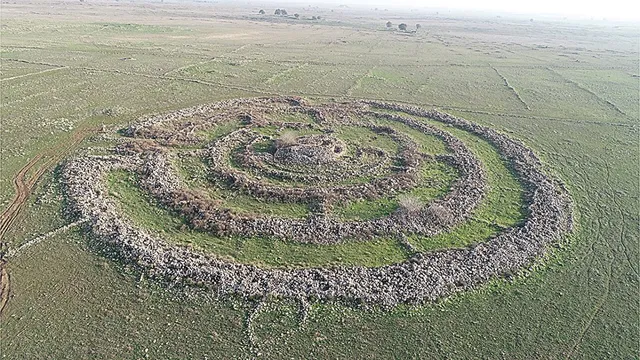
28 new ancient stone circles discovered in Israel
- Researchers from Ben-Gurion University discovered 28 additional stone circles near the Bronze Age monument Rujm el-Hiri in Israel.
- These circles were constructed from local basalt fieldstones and many exceed 160 feet in diameter.
- The study reveals the interconnectedness of these ancient structures, suggesting they were part of broader social and economic systems.
Story
In the Golan Heights of Israel, a team of researchers led by Ben-Gurion University of the Negev has identified at least 28 additional large stone circles surrounding the well-known Bronze Age monument Rujm el-Hiri. This monumental structure, dated to around 3,000 to 2,700 BCE, was previously thought to be a unique archaeological feature, but the recent findings challenge that notion. By leveraging satellite imagery and environmental analysis, the researchers revealed that these circles are part of a larger network of megalithic structures that existed during the Early Bronze Age. The unique characteristics of the stone circles, including their construction from local basalt fieldstones and their sizes, indicate they might have played critical roles in the lives of ancient inhabitants. Many of these newly discovered circles exceed 160 feet in diameter and feature circular walls, often with internal partitions. While Rujm el-Hiri consists of concentric walls from over 42,000 individual rocks, the other circles are generally smaller but still significant in size. Intriguingly, many of these sites are located near seasonal waterways, suggesting they were strategically placed for resource management and movement by ancient communities over 4,700 years ago. The proximity to water sources and agricultural systems hints at a broader understanding of the social and economic networks in the region. This integrated perspective not only enhances our understanding of the structures themselves but also sheds light on how ancient peoples organized and navigated their environments. The findings advocate for a reevaluation of important protohistoric monuments, recognizing their roles as potential gathering sites, territorial markers, or places for seasonal assemblies for herding communities. It underscores the value of advanced techniques like remote sensing and surface geophysical methods in archaeological research. By uncovering the hidden connections between these megalithic structures, this research contributes substantially to our knowledge of human history and the complex societies that existed in the Southern Levant region during the Early Bronze Age.
