

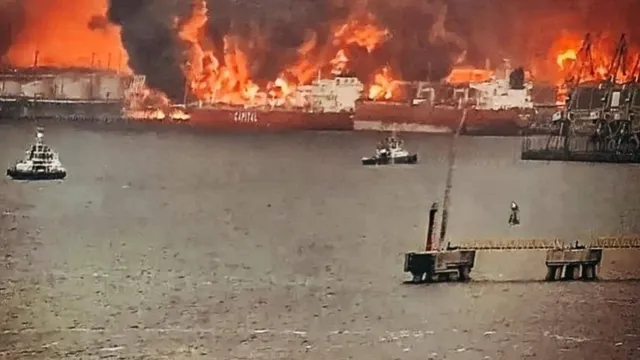
Ukrainian drone strikes devastate Russian oil export capabilities
Ukrainian drone strikes devastate Russian oil export capabilities
- Ukrainian drone strikes targeted key oil export facilities in Russia's Leningrad region over three days.
- The attacks have led to an estimated 50 percent reduction in Russian oil export capabilities, with significant damage reported at ports and refineries.
- Analysts warn that these disruptions could have serious long-term implications for Russia's oil industry and global oil markets.
Story
In March 2026, a series of drone attacks carried out by Ukrainian forces targeted key oil export facilities in Russia's Leningrad region, marking a critical escalation in the ongoing conflict. The assault began on March 23 with a strike on the Baltic port of Primorsk, which serves as a primary hub for Russia's oil shipments. This was followed on March 25 by a second attack on the Ust-Luga oil terminal, and on March 26, one of Russia's largest refineries in the Kirishi district was also hit. Energy analysts suggest these coordinated strikes have delivered a major blow to Russian oil exports, especially at a time when the Kremlin was set to benefit from rising global oil prices and a sanctions waiver from the United States amid the war with Iran. Boris Aronstein, an energy analyst quoted by Current Time, stated that these developments represent "the most serious threat" to Russian oil exports since the outset of the full-scale invasion of Ukraine in 2022. The assaults have resulted in an estimated hit of nearly 50 percent to Russian oil export capabilities, factoring in damage from the drone strikes as well as diminishing export traffic through alternative routes such as the Black Sea port of Novorossiisk and the Druzhba pipeline. In the aftermath of these attacks, ports such as Primorsk, Ust-Luga, and Novorossiisk demonstrated a significant decline in oil loading operations, with no oil being loaded for five consecutive days. The Center for Research on Energy and Clean Air reported ongoing disruptions at these terminals, primarily due to damage inflicted on vessel loading equipment and infrastructure. In addition to the ports, the drone strikes have also targeted oil facilities in the Caspian Sea, compounding the difficulties facing Russian oil transport. The implications of these attacks are far-reaching, disrupting not only export levels but also creating uncertainty in the market. Russian Deputy Prime Minister Aleksandr Novak has not openly acknowledged the extent of the damages but has raised concerns regarding the sustainability of Russia’s oil production amid ongoing military threats from Ukraine. Moreover, these attacks coincide with the seizure of several Russian-operated tankers, further complicating Russia's ability to maintain oil supply to countries like Hungary and Slovakia. With no resolution in sight for the war, analysts predict that Russian oil firms will remain hesitant to increase investments, leading to prolonged disruptions in oil exports.


