

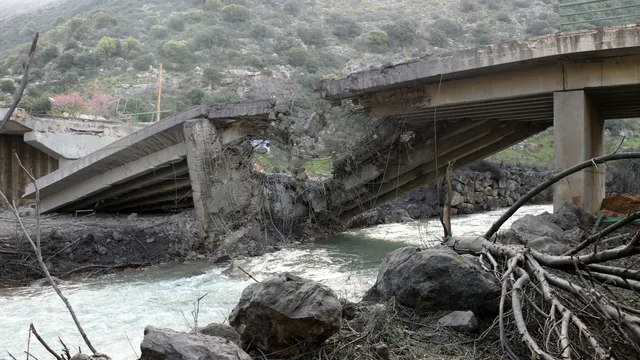
Israel admits to targeting civilian infrastructure in Lebanon amid conflict
Israel admits to targeting civilian infrastructure in Lebanon amid conflict
- Amid ongoing conflict, the Israeli military carried out airstrikes on Lebanon, targeting key infrastructure used by Hezbollah.
- International tensions have increased as the Lebanese government struggles to balance military aggression and internal security.
- Continued Israeli military actions raise significant legal and ethical questions about their implications for Lebanon and the region.
Story
Israel has conducted airstrikes in Lebanon, including a recent attack on the Tayr Filsay bridge, which marked a significant escalation in the ongoing conflict with Hezbollah. This strike was reportedly aimed at disrupting Hezbollah's movements across the country, as military officials claimed that the bridge was used by militants to facilitate attacks against Israel. The Israeli military has characterized its operations as defensive, seeking to protect its civilians from rocket attacks. Around 700 people have died in Lebanon due to airstrikes since hostilities reignited with Hezbollah's retaliation for the killing of Iran's supreme leader. Simultaneously, international tensions are rising as the U.S. war on Iran complicates the Lebanese government's position. The Lebanese authorities find themselves unable to both defend against Israeli aggression and disarm Hezbollah, which poses a significant internal challenge. Following the attacks, many countries, including Australia, have begun evacuating non-essential diplomats from Lebanon, indicating the growing concern over the escalating violence and instability in the region. However, the targeting of civilian infrastructure raises serious legal and ethical questions regarding international law and wartime conduct. While exceptions can be made if structures are used for military purposes, the Israeli military has not provided substantial evidence for its claim regarding the bridge. This approach contributes to fears that continued conflict could further destabilize Lebanon, leading to widespread humanitarian crises and displacing hundreds of thousands more individuals. Reports indicate that the situation may evolve into an even more severe conflict, reminiscent of past wars. Political analysts express concern that without a viable solution to disarm Hezbollah or address the humanitarian impact of military actions, Lebanon could confront a deteriorating situation akin to its past civil wars. As Hezbollah retains its military capabilities and internal rivals remain wary of potential conflict escalation, the prospects for stability in Lebanon and the broader Middle East region remain grim.
Context
The Israel-Hezbollah conflict has deep historical roots, tracing back to the establishment of the State of Israel in 1948 and the subsequent Arab-Israeli wars. Hezbollah, a Shiite militant group based in Lebanon, was founded in the early 1980s with the support of Iran and Syria, primarily as a response to the Israeli invasion of Lebanon in 1982. The organization initially focused on resisting Israeli occupation and providing socio-economic support to the Shiite population in southern Lebanon. Over time, Hezbollah evolved into a significant political and military force in Lebanon, successfully positioning itself as a defender of Lebanese sovereignty against Israeli aggression, while also exporting its model of armed resistance to other regions of the Middle East. The group's dual identity as both a political party and a militant organization complicates its role in the ongoing conflict, influencing both domestic and regional dynamics. The conflict between Israel and Hezbollah escalated significantly during the 2006 Lebanon War, a month-long military conflict triggered by Hezbollah's cross-border raid into Israel, which resulted in the abduction of two Israeli soldiers. The Israeli military response was intense, involving airstrikes across southern Lebanon and a ground invasion aimed at dismantling Hezbollah's capabilities. The war resulted in substantial infrastructure damage in Lebanon and significant civilian casualties. The international community called for ceasefires, leading to United Nations Security Council Resolution 1701, which aimed to establish a more robust peacekeeping presence in southern Lebanon. While the war ended without a clear victory for either side, Hezbollah emerged from the conflict with enhanced political legitimacy in Lebanon, portraying itself as a successful resistance movement against Israeli aggression. Tensions have persisted since the 2006 war, characterized by sporadic clashes along the Israel-Lebanon border and fears of renewed conflict. Both Hezbollah and Israel have engaged in strategies aimed at deterrence, with Israel conducting regular airstrikes against Hezbollah positions in Syria, where the group has been involved in the Syrian civil war, further complicating the regional security landscape. The rise of Iranian influence through Hezbollah has significantly altered power dynamics in the region, leading Israel to perceive Hezbollah's growing rocket arsenal as a direct threat. Israel's strategy has included preemptive military action to prevent the transfer of advanced weaponry to Hezbollah, highlighting the ongoing nature of the conflict and the potential for escalation. Strategically, the Israel-Hezbollah conflict remains emblematic of broader regional tensions involving Iran and its proxies, impacting negotiations and alliances across the Middle East. While both parties have called for stability, the volatile interplay of military capabilities, ideological differences, and geopolitical rivalries ensures that the conflict will remain a focal point of tension. The difficulty of achieving a lasting peace is underscored by complex historical grievances and the profound mistrust that characterizes the relationships between Israel, Hezbollah, and the surrounding Arab states. Understanding this conflict requires recognition of its multifaceted nature, involving not only military strategies and political maneuvering but also deep-seated narratives that inform both parties' identities and motivations.


