

Russian minister honors North Korean troops for bravery in Kursk region
Russian minister honors North Korean troops for bravery in Kursk region
- North Korean soldiers received the Order of Courage during a recent ceremony in Pyongyang for their role in the Kursk region.
- The memorial recognizes only a fraction of the significant North Korean military losses during the conflict in Ukraine.
- The events signify a deepening military cooperation between North Korea and Russia amid ongoing geopolitical tensions.
Story
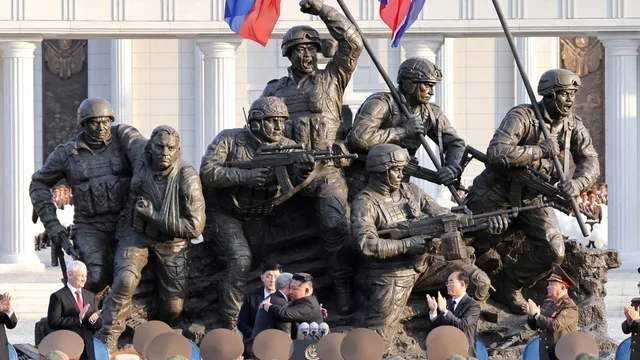
In a significant gesture of military cooperation, North Korean soldiers were awarded the Order of Courage by Russian Defense Minister Andrey Belousov during a visit to Pyongyang. This honor was presented to troops who had participated in efforts to liberate Russia's Kursk region from Ukrainian forces, illustrating the deepening ties between the two countries following a Comprehensive Strategic Partnership Treaty established in June 2024. The North Korean military involvement included repelling a large-scale incursion by Ukrainian forces and undertaking mine-clearing activities in the area. The ceremony, held recently, highlighted the strong military relationship developing between North Korea and Russia amid ongoing tensions in the region. Belousov praised the North Korean forces as "true heroes of our time" during the event, and expressed gratitude on behalf of the Russian people for their contributions. As part of the military collaboration, discussions regarding future defense cooperation, including a Military Cooperation Plan for 2027-2031, were also held, demonstrating both nations' intentions to further their military agendas. Parallel to these events, North Korea opened a memorial honoring soldiers who had fallen during the conflict in Ukraine. This memorial, inaugurated on April 26, serves as a reminder of the sacrifices made by approximately 2,000 North Korean soldiers, although only a fraction of these troops have been publicly commemorated. The relatively small number of honored soldiers is indicative of the regime's social classification system, which determines individuals' loyalty to the ruling party. This selective recognition is believed to bolster North Korea's efforts to project a narrative of reliability and loyalty to the regime while overshadowing the larger casualty numbers. Additionally, Pyongyang's decision to publicly memorialize these soldiers aids in reinforcing its military dedication to Russia, acting as a communication that underscores North Korea's commitment to mutual interests with Russia amidst geopolitical instability. In return for its military support, North Korea has reportedly received aid in various forms from Russia, including food and technical assistance, underscoring the transactional nature of their alliance.
Context
The history of Russian-North Korean military cooperation is rooted in the post-World War II era, as both nations sought to bolster their defenses and strategic interests in a rapidly changing geopolitical landscape. Following the end of the war, the Soviet Union played a crucial role in the establishment of North Korea, aiding in its military development and infrastructure. This initial engagement laid the groundwork for a long-lasting relationship characterized by military aid, training, and the sharing of technology. The Cold War period saw a significant intensification of this cooperation, with the Soviet Union providing military equipment and support to North Korea, particularly during the Korean War when Soviet airpower played a decisive role against United Nations forces. Throughout the decades, the military alignment between Russia, then the Soviet Union, and North Korea was marked by mutual interests in countering United States influence in the region. The Soviet Union's military assistance included advanced weaponry, tanks, artillery systems, and training for North Korean military personnel. Moreover, this partnership allowed North Korea to sustain its military capabilities while deterring perceived threats from South Korea and its allies. This military cooperation was further solidified in the agreements signed during various state visits and diplomatic exchanges between leaders of both nations. The dissolution of the Soviet Union in 1991 brought a shift in the dynamics of Russian-North Korean military relations. During the 1990s, Russia underwent substantial political and economic changes that impacted its foreign policy. However, North Korea's strategic importance, particularly as a buffer state against U.S. forces and influence in Northeast Asia, ensured continued military dialogue. Throughout the late 20th and early 21st centuries, Russia often acted as a mediator in international crises involving North Korea, exhibiting a careful balancing act between maintaining military ties and adhering to international agreements concerning nuclear proliferation. As of 2026, the current state of Russian-North Korean military cooperation reflects both historical ties and contemporary geopolitical considerations. The relationship has been largely influenced by global dynamics such as North Korea's nuclear ambitions and the ongoing tension in the Korean Peninsula. In recent years, Russia has continued to express support for North Korea's sovereignty while advocating for diplomatic solutions to reduce tensions and prevent conflict. The evolving military cooperation might involve collaborations in cyber defense, intelligence sharing, and potential arms trade, which resonate with both countries' interests as they navigate an increasingly complex international environment. The trajectory of this cooperation will likely depend on both nations' responses to external pressures and their strategic priorities in the ever-shifting landscape of global politics.


