

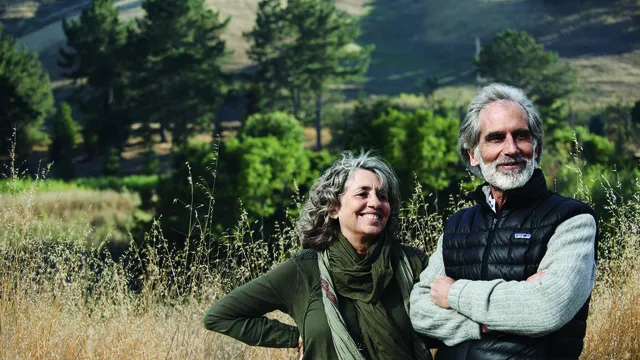
Amy's Kitchen builds a billion-dollar empire with organic ingredients
Amy's Kitchen builds a billion-dollar empire with organic ingredients
- Amy's Kitchen was founded by Andy and Rachel Berliner nearly four decades ago in Petaluma, California, to support their daughter's education.
- The company's approach combines organic ingredient use and restaurant-style food production, standing out in a mechanized industry.
- The Berliners' commitment to sustainability and employee benefits has helped them scale their business while maintaining their core values.
Story
In California, founders Andy and Rachel Berliner started Amy's Kitchen nearly four decades ago from their home in Petaluma, driven by a need to support their daughter's education. Their business has thrived with a focus on organic food, remaining a certified B Corporation which emphasizes sustainable and ethical practices. Unlike many in the frozen food industry, they approach production as a restaurant-style operation rather than a mechanized factory, which has allowed them to maintain quality without losing their identity. Over the years, as they scaled their operations, their commitment to providing health-conscious options has resonated with a growing consumer base seeking organic alternatives. The Berliners’ journey reflects changes in the food industry, from the introduction of organic standards to shifting consumer preferences toward healthier options. Rachel Berliner recalls her early exposure to organic principles from her mother, citing a time when organic food was considered fringe. This background informed their approach to production, prioritizing quality ingredients, which cost significantly more than conventional options. They have invested in employee benefits, bolstering their workforce's commitment and reflecting their belief in nurturing relationships with both employees and customers. Their practices have gained attention in light of recent political shifts regarding food policy, with heightened regulations emphasizing organic farming. Amy's Kitchen has adapted to these changes while continuously investing in community and employee wellness opportunities, including mental health services and educational scholarships. They recognize their success as a validation of their long-standing philosophy that prioritizes health and sustainability, an ethos they hope will inspire others in the food production sector. Rachel's acknowledgment of the political landscape also hints at a future where the demand for organic products may continue to rise, pushing companies like Amy's Kitchen to stay ahead of industry trends. As they plan to grow and possibly expand their focus into new regions, their commitment to organic practices remains central to their mission. With each step forward, the Berliners hold fast to their core values, striving to make quality organic food accessible to a wider audience, thus solidifying their place in the vibrant and continually evolving food industry.
Context
The history of the organic food industry can be traced back to the late 19th and early 20th centuries, emerging as a reaction to the industrialization of agriculture. During this time, several individuals, including those like Sir Albert Howard and Rudolf Steiner, began advocating for farming practices that emphasized the importance of soil health, biodiversity, and sustainable farming techniques. The organic movement gained momentum in the 1940s and 1950s, as the health risks associated with synthetic fertilizers and pesticides became apparent. These early pioneers laid the groundwork for what would eventually become a formalized organic food industry, advocating for practices that aimed to minimize environmental impact while maximizing nutritional value and food quality. By the 1970s, demand for organic produce began to rise in the United States and Europe, spurred on by growing consumer awareness of food quality and safety concerns, as well as the broader environmental movement. The establishment of organic certification programs in the 1980s, particularly the National Organic Program in the United States in 2000, formalized standards for organic farming and established necessary regulations to ensure integrity for consumers. This period also saw the rise of various organic co-ops, farmers' markets, and specialty grocery stores, making organic food more accessible to the average consumer. As the new millennium approached, the organic food industry expanded dramatically, with mainstream supermarkets adding organic selections to their shelves. This shift was driven by increasing consumer demand fueled by the perception that organic food was healthier and more environmentally friendly. The market also attracted a growing number of farmers who transitioned from conventional to organic farming methods, seeing potential for higher profit margins and consumer loyalty. This transition, while beneficial in many respects, also sparked debates regarding the authenticity of organic claims and highlighted challenges, such as the need for rigorous enforcement of organic standards. Today, the organic food industry is a global phenomenon, with billions of dollars in sales and a diverse range of products available worldwide. Awareness of sustainable and ethical food production continues to shape trends within the industry, including a growing focus on regenerative agriculture, local sourcing, and transparency in the food supply chain. Despite facing challenges such as climate change and market fluctuations, the organic food industry remains resilient, reflecting increasing consumer interest in health, sustainability, and quality food.


