

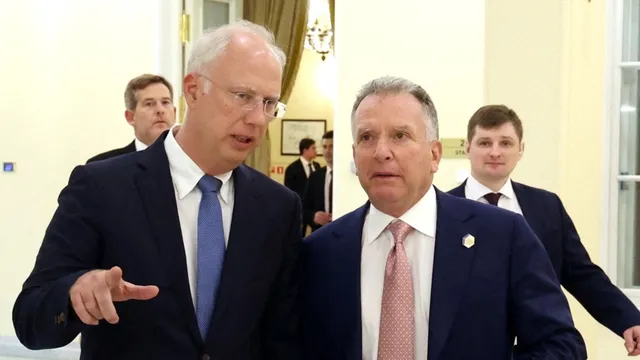
Steve Witkoff heads to Moscow for crucial Ukraine peace talks
Steve Witkoff heads to Moscow for crucial Ukraine peace talks
- Steve Witkoff will travel to Moscow next week to meet with President Vladimir Putin, marking his sixth trip aimed at finding a resolution to the Ukraine conflict.
- The US-backed peace proposal has elicited significant skepticism from Ukrainian leaders and European officials due to concerns about its alignment with Russian demands.
- Witkoff's negotiations come amid an urgent military situation in Ukraine, as pressure mounts for a viable agreement to end the ongoing war.
Story
On November 26, 2025, White House envoy Steve Witkoff announced his forthcoming trip to Moscow, which marks his sixth visit since January to discuss peace efforts concerning the ongoing war in Ukraine. The Kremlin confirmed this visit amidst rising tensions and criticism regarding a US-backed peace proposal that has sparked wariness among Ukrainians and European leaders alike. Witkoff's engagement follows intense negotiations among US, Ukrainian, and Russian officials in various cities, highlighting the intricate dynamics in play. In recent discussions pushing for an end to the nearly four-year-long conflict, key figures from multiple countries have been embroiled in wrangling over critical issues like territorial claims and military restrictions. The intricate discussions stem from Ukraine's critical military situation, as its armed forces grow increasingly beleaguered under the protracted invasion. Furthermore, a recently leaked US peace plan recipients, including Ukrainian President Volodymyr Zelenskyy, have raised alarm due to the US proposal’s alignment with Russian demands, further complicating discussions. The escalating criticism directed at the US plan reflects deep-seated fears regarding territorial integrity and sovereignty, as many observers argue the plan heavily favors Russian interests. Ukrainian officials are particularly concerned about Russia's ongoing demands for control of Donetsk, a region whose alignment remains contested, as well as Moscow’s insistence that Ukraine cannot join NATO. Additionally, during his visit, Witkoff is expected to address criticisms about his previous misunderstandings of the situation based on past negotiations, which had been perceived as favoring Russian perspectives. Adding to the intrigue surrounding this mission, an October 14 phone call between Witkoff and a Russian official named Yuri Ushakov was leaked, suggesting collaborative strategies for negotiating a cease-fire. Although President Donald Trump associated with the sentiments during a press briefing, setbacks triggered by the leaks might influence negotiations. As Witkoff prepares to meet with President Vladimir Putin imminently, the response from Ukraine remains uncertain. A potential struggle over the peace deal could ensue depending on whether Witkoff successfully navigates the complex political landscape and incorporates Ukrainian interests moving forward.
Context
The relationship between the United States and Russia has been significantly influenced by the events surrounding Ukraine, particularly since 2014. The annexation of Crimea by Russia marked a turning point that intensified tensions between the two nations. Following this act, the United States, alongside its allies, responded by implementing a range of economic sanctions aimed at key sectors of the Russian economy. These sanctions were designed not only to penalize Russia for its aggressive actions but also to serve as a deterrent against further territorial expansion into Ukraine and other neighboring countries. The strategic importance of Ukraine as a former Soviet republic and a current battleground for influence between the West and Russia has made this region critical for both U.S. foreign policy and Russia's national interests. In the years following the annexation, U.S.-Russia relations continued to deteriorate, especially with the onset of conflict in Eastern Ukraine. The United States supported the Ukrainian government with military aid and training while condemning Russian support for separatist groups in the Donbas region. NATO also responded by increasing its presence in Eastern Europe, conducting military exercises, and reassuring member states in close proximity to Russia. This period saw heightened military tensions, with both sides accusing each other of escalating the conflict, thereby leading to an environment characterized by distrust and hostility. The situation further complicated with subsequent events such as the poisoning of Russian opposition leader Alexei Navalny, cyber intrusions attributed to Russian actors, and interference in U.S. domestic affairs, particularly during election cycles. These actions prompted further sanctions and diplomatic condemnation from the United States, exacerbating an already fragile relationship. Diplomatic dialogues attempted to address these tensions, yet they have often foundered on the conflicting priorities of both nations, particularly concerning Ukraine's sovereignty and territorial integrity. As of late 2025, the state of U.S.-Russia relations remains precarious, with ongoing disputes over Ukraine continuing to serve as a central point of contention. While both countries have engaged in some limited forms of dialogue, comprehensive resolutions appear distant. The geopolitical ramifications of the U.S.-Russia relationship will likely remain influenced by Ukraine’s political climate and territorial disputes, demonstrating the interconnectedness of regional stability and international relations. As the situation evolves, the international community watches closely, as any significant developments could have far-reaching implications not just for U.S.-Russia relations, but for global security as a whole.


