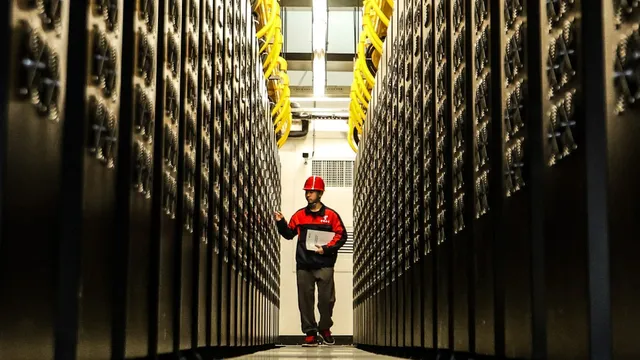
China's LineShine surpasses El Capitan as world's fastest supercomputer
technology
impactful
innovative

China's LineShine surpasses El Capitan as world's fastest supercomputer

21
(Update: )
country in East Asia
former passenger train
  • China's LineShine has achieved a performance of 2.198 exaflops, surpassing the US's El Capitan.
  • This marks the first time since 2017 that a Chinese supercomputer has topped the TOP500 list.
  • The shift in rankings highlights the growing competition between China and the US in advanced technology.
Share opinion
2

Story

In a significant technological shift, China has claimed the top position in the global supercomputer rankings, marking a pivotal moment in the ongoing competition between China and the United States. The TOP500 list, which ranks supercomputers based on their performance, revealed that China's LineShine, located at the National Supercomputing Centre in Shenzhen, achieved a remarkable performance of 2.198 exaflops. This performance translates to over 2 quintillion calculations per second, giving it a 20 percent lead over the previous leader, the US-based El Capitan, which had held the top spot since November 2024. The announcement was made during the biannual ranking event held in Hamburg, Germany, highlighting China's advancements in supercomputing technology. LineShine's achievement is particularly noteworthy as it is the first system to exceed 2 exaflops using a CPU-only design, a departure from the more common GPU-based systems that dominate the field. This development underscores China's growing capabilities in high-performance computing, which is crucial for various applications, including scientific research and artificial intelligence. The competition between China and the US in the realm of supercomputing reflects broader geopolitical tensions, with both nations striving for supremacy in cutting-edge technologies. The US has historically led in supercomputing, but China's recent advancements indicate a shift in the balance of power. The TOP500 list has been a key indicator of supercomputing performance since its inception in 1993, but experts note that its relevance may be diminishing in the age of AI, where corporate tech giants like Microsoft and Amazon are at the forefront. As the landscape of supercomputing evolves, the implications of this shift are significant. While the US continues to produce leading AI models, China is rapidly closing the gap in AI model performance and holds advantages in patent production and industrial robot installations. The rivalry between the two nations is expected to intensify, with both sides implementing sanctions and export controls to hinder each other's technological advancements. The recent ranking serves as a reminder of the fierce competition that characterizes the current technological landscape, with both countries vying for dominance in the future of AI and supercomputing.

Context

The impact of supercomputing on AI development has been profound and transformative, shaping the landscape of artificial intelligence research and applications. Supercomputers, with their immense processing power and advanced architectures, enable researchers to tackle complex problems that were previously deemed insurmountable. This capability is particularly crucial in fields such as deep learning, where large datasets and intricate models require significant computational resources. The ability to run simulations and process vast amounts of data in real-time accelerates the training of AI models, leading to faster advancements in machine learning techniques and applications across various domains, including healthcare, finance, and climate modeling. One of the key contributions of supercomputing to AI development is the enhancement of model training efficiency. Traditional computing resources often struggle with the scale of data and complexity of algorithms used in modern AI. Supercomputers, however, can distribute tasks across thousands of processors, significantly reducing the time required to train models. For instance, breakthroughs in natural language processing and image recognition have been made possible by leveraging supercomputing resources, allowing researchers to experiment with larger datasets and more sophisticated architectures, such as transformer models. This has led to the creation of AI systems that are not only more accurate but also capable of understanding context and nuance in ways that were previously unattainable. Moreover, supercomputing facilitates the exploration of new AI methodologies and the optimization of existing ones. Researchers can conduct extensive experiments to fine-tune algorithms, test various configurations, and analyze the performance of different models under diverse conditions. This iterative process is essential for developing robust AI systems that can generalize well to real-world scenarios. Additionally, supercomputing resources enable the simulation of complex environments, which is particularly beneficial for training AI in fields like robotics and autonomous systems. By simulating real-world challenges, researchers can prepare AI agents to navigate and respond to dynamic situations effectively. In conclusion, the synergy between supercomputing and AI development is a driving force behind the rapid advancements in the field. As supercomputing technology continues to evolve, it is expected to further enhance the capabilities of AI, enabling researchers to push the boundaries of what is possible. The ongoing collaboration between supercomputing facilities and AI research institutions will likely yield innovative solutions to some of the most pressing challenges facing society today, ultimately leading to a future where AI can contribute meaningfully to various sectors and improve the quality of life for individuals around the globe.

2026 All rights reserved