

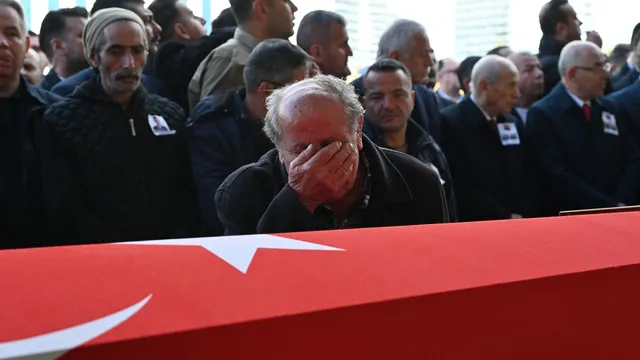
Turkey grounds C-130 planes after deadly crash kills 20 soldiers
Turkey grounds C-130 planes after deadly crash kills 20 soldiers
- The crash occurred on Tuesday when a Turkish C-130 Hercules military plane fell shortly after taking off from Ganja, Azerbaijan.
- All 20 military personnel on board were killed, marking Turkey's deadliest military incident in years.
- In response, Turkey has grounded its C-130 fleet for inspections and investigations into the crash.
Story
A Turkish C-130 Hercules military cargo plane crashed in Georgia, resulting in the deaths of all 20 military personnel on board. The tragic incident occurred shortly after the aircraft took off from Ganja, Azerbaijan, which was en route to Turkey. The crew was reportedly responsible for maintaining Turkish F-16 jets that had participated in Azerbaijan's Victory Day celebrations. Initial investigations suggest that the plane may have experienced a catastrophic event, possibly an explosion, based on the rapid breakup of the aircraft observed before its crash. The aircraft in question was a 57-year-old military model, purchased from Saudi Arabia in 2012 and modernized in recent years, entering service in 2022. Despite its age, experts noted that the C-130 Hercules is generally regarded as a safe and forgiving aircraft, though the circumstances of this specific crash are uncommon. Eyewitness accounts and video footage depict the plane breaking apart mid-air, compelling a focus on what could have led to such a catastrophic failure. In response to the crash, Turkey's Defense Ministry has temporarily grounded all C-130 operations pending a thorough investigation and technical inspections. The plane's flight data and cockpit voice recorders have been retrieved and sent to Ankara for analysis. This tragic event marks the deadliest military incident for Turkey in the last five years, prompting extensive rescue and investigation efforts involving over 1,000 personnel from both Turkey and Georgia. As the situation unfolds, with autopsies and funerals expected for the victims, the repercussions of this disaster may impact both Turkey’s military operations and their aviation protocols. It also raises broader questions about the safety regulations and maintenance practices of aging military aircraft in conflict zones. Meanwhile, details regarding the specifics of what led to the crash remain under investigation, with findings likely to influence future aviation contracts and policies within the Turkish military.
Context
The C-130 Hercules is a military transport aircraft designed and built by Lockheed Martin. Introduced in 1956, this versatile aircraft has played a vital role in numerous military operations and humanitarian missions around the world. Its design was conceived in the early 1950s when the U.S. Air Force required a tactical airlifter that could operate from short and unpaved airstrips. The C-130 was tailored for specific needs, featuring four turboprop engines, a high-wing design, and a rear ramp that allows for quick loading and unloading of cargo including troops, medical supplies, and vehicles. The aircraft's ability to perform various roles, including airlift, reconnaissance, and aerial firefighting, has made it an essential asset in various military and civilian operations for over six decades. Over the years, the C-130 has undergone numerous upgrades and modifications to adapt to changing military requirements and technological advancements. Variants of the Hercules include the C-130J Super Hercules, which offers improved performance, more efficient engines, and advanced avionics. The aircraft’s design has enabled it to take on diverse roles, such as medivac operations, aerial refueling, and even search and rescue missions. This flexibility is crucial in combat scenarios where conditions can change rapidly. The C-130's ability to operate in short and austere environments has allowed it to be deployed in a wide range of theaters, from the jungles of Vietnam to the deserts of the Middle East, always proving its effectiveness and reliability. In addition to its military applications, the C-130 has been utilized in humanitarian missions worldwide, often responding to natural disasters, delivering supplies, and supporting relief efforts in remote areas where traditional aircraft cannot function. The aircraft's robust design allows for operation in adverse weather conditions and at low altitudes, which is optimal for delivering humanitarian aid directly where it is needed most. This dual capability enhances the aircraft's reputation as a versatile tool for both combat and civilian applications, often promoting goodwill and support for the U.S. and allied forces in international crises. As of 2025, the C-130 Hercules remains in service with numerous air forces around the globe, demonstrating its longevity and adaptability. With over 2,500 units built and continuous upgrades, its legacy is firmly established in both military history and aviation innovation. The aircraft symbolizes the evolution of military transport capabilities, showcasing the importance of versatility, durability, and the capacity to meet diverse operational demands. The ongoing operational success and extensive service life of the C-130 highlight its significance, making it one of the most iconic and enduring aircraft in aviation history.


