
politics
controversial
impactful

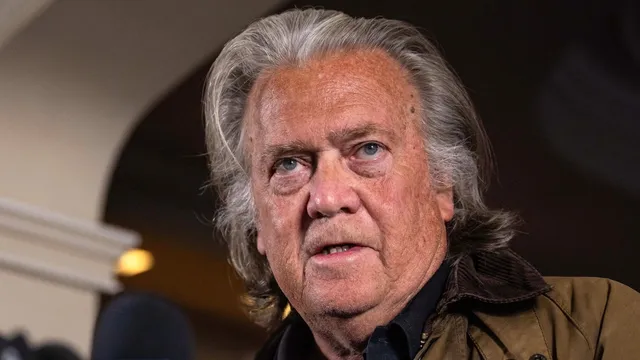
Supreme Court clears way for Bannon's contempt conviction dismissal

Apr 6, 2026, 2:00 AM51
(Update: Apr 6, 2026, 6:43 PM)
president of the United States from 2017 to 2021
American media executive & political strategist (born 1953)
highest court in the United States

Supreme Court clears way for Bannon's contempt conviction dismissal

  • The U.S. Supreme Court dismissed a ruling that upheld Steve Bannon's contempt of Congress conviction, previously imposed for refusing to testify about the January 6 Capitol riot.
  • The Trump administration requested the dismissal, arguing it aligns with the interests of justice, following a change in the government's legal strategy.
  • This legal decision opens the door for potentially symbolic dismissal of charges, as Bannon has already served his sentence.
Share opinion
Tip: Add insight, not just a reaction
5

Story

In early April 2026, the U.S. Supreme Court took significant action by addressing the ongoing legal battles of Steve Bannon, a prominent ally of former President Donald Trump. The Court's decision involved a motion to dismiss Bannon's contempt of Congress conviction, stemming from his refusal to comply with subpoenas related to the January 6, 2021, Capitol riot investigation. The case originally began in 2022 when Bannon was convicted on two counts of contempt and subsequently served a four-month sentence after exhausting his appeals. The Supreme Court's recent ruling sent the case back to a lower court in Washington, D.C., effectively nullifying an earlier appellate court decision that had upheld Bannon's conviction. This move was largely influenced by the current Trump administration's request, which argued that dismissing the case was "in the interests of justice." The Department of Justice had already indicated their desire to see the charges against Bannon dropped, reflecting a shift in legal strategy since the Biden administration initially pursued the prosecution. Bannon's legal team maintained that his defiance of the congressional subpoena was based on his belief that he could not comply due to President Trump's assertion of executive privilege. However, this argument faced skepticism, given Bannon's status as a private citizen at the time of the events leading to the Capitol riot. The Supreme Court's decision on this matter carries implications beyond the individual case, touching on broader questions of executive privilege, congressional authority, and the politicization of legal actions. While the actual dismissal would be primarily symbolic, considering Bannon's prison time has already been served, it highlights ongoing tensions between political interests and the justice system. Bannon has positioned himself as a victim of a politically motivated prosecution and continues to leverage his notoriety through media platforms such as his podcast. The unfolding legal saga of Steve Bannon serves as a reflection of the polarized state of American politics, where legal outcomes can significantly intersect with national political narratives.

Context

The relationship between Congress and the Supreme Court regarding the issue of contempt of Congress is a critical aspect of the separation of powers outlined in the U.S. Constitution. Contempt of Congress occurs when individuals refuse to comply with subpoenas or obstruct the work of congressional investigations. Historically, the courts have been cautious in intervening in matters of congressional contempt, emphasizing the importance of legislative functions and the authority that Congress possesses to conduct oversight. This dynamic has led to several pivotal Supreme Court rulings that have shaped the contours of parliamentary privilege and the enforcement of congressional subpoenas. Several landmark Supreme Court cases illustrate the evolving interpretation of contempt of Congress. Notably, in the case of "Watkins v. United States" (1957), the Court ruled that congressional investigations must be related to a legitimate legislative purpose and that individuals have the right to invoke the Fifth Amendment to refuse self-incrimination during such inquiries. This ruling underscored the need for a balance between legislative authority and individual rights, setting a critical precedent for future cases involving congressional investigations and contempt. Additionally, the Supreme Court's decision in "Eastland v. United States Servicemen's Fund" (1975) reaffirmed Congress's inherent authority to conduct investigations. The Court held that congressional testimony and evidence could not be challenged in court as long as the inquiries pursued a valid legislative purpose. This ruling significantly enhances Congress's ability to enforce subpoenas, as the Court acknowledged that legislative inquiries are part of Congress's core functions. However, it also left room for the courts to adjudicate disputes regarding the scope and validity of subpoenas, thereby emphasizing the intricate balance of power between the legislative and judicial branches. In more recent years, cases arising from investigations into executive branch actions have intensified the conversation regarding contempt of Congress. With the political landscape continuously evolving, the Supreme Court's interpretations remain vital in determining the effectiveness of congressional oversight and the enforcement of its subpoenas. As such, the rulings on contempt of Congress continue to play an essential role in shaping the dialogue between the legislative and judicial branches, ensuring both the accountability of public officials and the protection of constitutional rights.

2026 All rights reserved
