

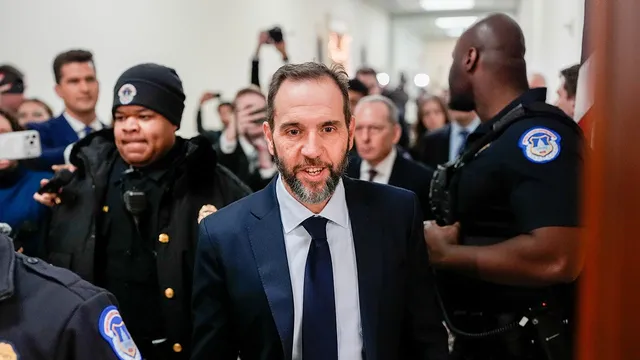
Jack Smith testifies Trump engaged in criminal actions during investigation
Jack Smith testifies Trump engaged in criminal actions during investigation
- Jack Smith appeared before the House Judiciary Committee to defend the charges against Donald Trump.
- Smith emphasized that his investigations were based on substantial evidence of criminal activity.
- The hearing highlighted the ongoing political tensions and implications for the upcoming presidential election.
Story
In the United States, former special counsel Jack Smith appeared before the House Judiciary Committee to testify regarding his investigations into President Donald Trump. During this public hearing on January 18, 2026, Smith defended the charges he brought against Trump, stating they were based on extensive evidence that showed Trump had knowingly broken laws designed to uphold democracy. He emphasized that Trump engaged in a criminal scheme to overturn the results of the 2020 presidential election while also hindering justice related to classified documents. Smith argued throughout his testimony that he acted without political bias, asserting that anyone in Trump’s position would have faced similar consequences for their actions. Smith’s appearance before the committee marked his second testimony; his first was a closed-door session in December 2025. In this latest public hearing, he reiterated his belief that his investigations were appropriate and firmly adhered to Justice Department policies against election interference. Smith stated that the decision to indict Trump was based solely on the facts gathered during the probe, which he claimed provided proof beyond a reasonable doubt that criminal activity had occurred. Despite pressure and allegations of politicization from Republican lawmakers, Smith maintained that the integrity of his investigations remained intact. Moreover, during his testimony, Smith addressed allegations from Trump and his allies that his charges were politically motivated. He stated unequivocally that had the evidence pointed toward a Democrat engaging in similar misconduct, he would have forged ahead with prosecution. His assertions served to underline his position that accountability should extend to all individuals regardless of their political affiliations. Smith's defense was met with a mix of skepticism and criticism from Republican committee members, who described his methods as overly aggressive and questioned whether they fell within his mandates as special counsel. The outcome of the hearing highlighted the contentious political atmosphere surrounding Trump's legal issues and the ongoing threats to the legitimacy of the justice system. Smith's testimony was a critical moment not only for the investigations but also for how these legal battles intersect with the upcoming presidential election. As political tensions run high, the implications of Smith's findings and Trump's subsequent claims of innocence continue to resonate across America, impacting public opinion and the political landscape. The hearing emphasized the realities of a polarized America, where legal interpretations and motivations are debated vigorously, illustrating the challenges faced in delivering justice within a fractured political environment.
Context
The history of special counsel testimonies before Congress is a critical aspect of the oversight and accountability mechanisms within the U.S. federal government. Special counsels are appointed to investigate matters that might present a conflict of interest for regular prosecutors, particularly when high-ranking officials are involved. Historically, these investigations have generated substantial political discourse, often culminating in testimonies before congressional committees. Noteworthy examples include the testimonies of special counsels like Kenneth Starr and Robert Mueller, each of whom faced intense scrutiny and vigorous questioning from lawmakers regarding their investigations into allegations of misconduct by sitting presidents and their associates. Kenneth Starr's investigation in the late 1990s into President Bill Clinton's alleged misconduct culminated in a testimony before Congress that became marked by partisan divisions. His testimony was not only a public summation of his findings but also a pivotal moment in the impeachment proceedings against President Clinton. Starr's responses highlighted the challenges and expectations faced by special counsels when they navigate the complexities of legal findings and political realities. This case set a precedent for how special counsel testimonies are conducted, reflecting both the investigative objectives and the intricate relationship between legal and political processes. Similarly, Robert Mueller's testimony in July 2019, following his investigation into Russian interference in the 2016 election, reignited debates about presidential accountability and the limits of executive power. Mueller's carefully measured responses were scrutinized by members of both parties as they sought to frame the implications of his findings. His reluctance to go beyond his written report emphasized the constraints under which special counsels operate, often navigating the expectations of Congress while adhering to judicial norms. The testimony highlighted the significant role special counsels play in clarifying complex and, at times, contentious issues concerning national security and electoral integrity. Congressional testimonies by special counsels serve as a critical window into the interplay between legal findings and congressional oversight. They reveal not only the outcomes of high-profile investigations but also signal the importance of transparency and accountability in governance. The evolving nature of these testimonies underscores the need for clear protocols and mutual understanding on both sides of the aisle. As seen in the past, the impact of these testimonies extends beyond the courtroom, influencing public opinion, legislative priorities, and the future conduct of government officials.


