

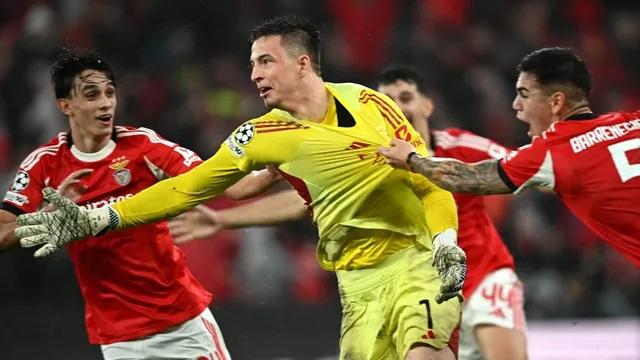
Anatoliy Trubin scores last-minute header to boost Benfica in Champions League
Anatoliy Trubin scores last-minute header to boost Benfica in Champions League
- Anatoliy Trubin scored a crucial 98th-minute goal to help Benfica win and secure a spot in the Champions League playoffs.
- Real Madrid, despite leading initially, suffered from several dismissals that impacted their performance against Benfica.
- The outcome of the match highlights the tournament's dynamic format, allowing for unexpected twists and more inclusive competition.
Story
In Portugal, Benfica goalkeeper Anatoliy Trubin scored an incredible 98th-minute header that secured his team a crucial 4-2 victory against Real Madrid during a tense Champions League match on January 28. The victory not only allowed Benfica to advance into the playoff round but also denied Real Madrid an automatic spot in the knockout stage. Initially trailing 1-0 after Kylian Mbappe scored for Real, Benfica rallied to take a 3-2 lead, only to face the threat of elimination until Trubin's dramatic goal came in stoppage time. The match showcased dramatic moments, with Real Madrid's poor discipline resulting in two red cards, significantly altering the dynamics of the game. Benfica had entered the last play of the match needing one final goal to advance based on goal difference, and Trubin's forward movement for a free kick proved to be a game-changing tactic orchestrated by their coach, Jose Mourinho. As the game entered stoppage time, Real Madrid's Raul Asencio and Rodrygo were sent off, leaving them with nine players on the pitch, further complicating their efforts to equalize. Benfica's scoring growth was marked by impressive performances, including two goals from Andreas Schjelderup and a penalty scored by Vangelis Pavlidis. Mbappe managed to net twice for Real Madrid, fueling their initial hope for finishing in the top eight of the tournament. Nonetheless, Real Madrid, having enjoyed a strong start in prior matches, faced a disappointing setback that highlighted their inconsistency, as pointed out by Mbappe in his post-match comments. He noted that the lack of hunger and desire compared to Benfica ultimately contributed to their downfall. The match and its outcomes not only affected the specific teams involved but also posed significant implications for the tournament's new structure, which allows teams beyond the traditional elite to compete more vigorously for advancement. This evolving format has already created a more dynamic and inclusive competition environment, leading to exhilarating moments like Trubin's goal that turned the fate of both clubs dramatically within seconds. Overall, the match was a high-stakes affair that exemplified the intense nature of European football and the emotional roller-coaster that it often provides fans.
Context
The UEFA Champions League, one of the most prestigious football tournaments in the world, employs a format that is both exciting and competitive, drawing attention from millions of fans globally. The playoffs, essentially the knockout stage of the tournament, begin after the conclusion of the group stage, where top teams from various European leagues compete to secure their places in the next round. Teams are divided into seeded and unseeded categories based on their performance in previous competitions and current rankings, ensuring that the most formidable teams do not face each other in the initial rounds of the playoffs. This seeding system adds an element of strategy as clubs aim to navigate through the tournament while managing their resources effectively to advance further. In the knockout stage, ties are played over two legs, with each team hosting one match. This format allows teams to showcase their abilities at home and away, providing fans with a thrilling atmosphere. The aggregate score over the two matches determines which team progresses to the next round. If the aggregate score is tied at the end of the second leg, the match goes into extra time, and if necessary, a penalty shootout ensues to decide the winner. The possibility of dramatic comebacks and nail-biting finishes makes these playoff rounds particularly captivating. The structure of the Champions League playoffs emphasizes the strength and depth of European football, showcasing teams from various nations, each with unique playing styles and strategies. Historically, clubs from countries like Spain, England, Italy, and Germany have dominated the competition, but the playoff format allows for the emergence of dark horses—teams that may surprise stronger opponents. This unpredictability not only fuels fan engagement but also contributes to the growth of football in nations that may not yet be recognized as powerhouses in the sport. The playoff rounds culminate in the final, where the remaining two teams compete for the coveted trophy, representing the pinnacle of club football. This climactic match brings together fans from around the world, uniting supporters of diverse backgrounds in a celebration of the sport. The UEFA Champions League playoffs, therefore, not only serve as a battleground for clubs seeking glory but also as a showcase of talent, determination, and the enduring spirit of competition in football.


