

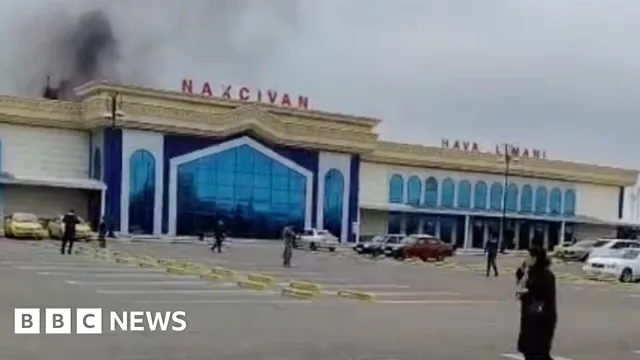
Azerbaijan retaliates after Iran drone attack injures civilians
Azerbaijan retaliates after Iran drone attack injures civilians
- On March 5, 2026, drones launched from Iran struck Azerbaijan’s Nakhchivan region, causing injuries to two civilians.
- Azerbaijan condemned the attacks as an act of terror and summoned the Iranian ambassador for explanations.
- The incident highlights the complex relationship between Azerbaijan and Iran amid rising tensions in the Middle East.
Story
Azerbaijan, situated in the South Caucasus region, experienced a hostile incident on March 5, 2026, when drones purportedly launched from Iran struck its Nakhchivan autonomous region. The attacks resulted in injuries to two civilians and caused damage to both Nakhchivan Airport and a school in the vicinity. The Azerbaijani government swiftly condemned the incident, labeling it an act of aggression, and summoned the Iranian ambassador for an explanation. Azerbaijan has long navigated complex relations with Iran, especially given its military and economic partnerships with Israel, which complicates the geopolitical landscape further. In a statement, Azerbaijani officials expressed their intent to respond decisively to the attack, underscoring their right to take retaliatory measures. President Ilham Aliyev referred to the drone strikes as a 'groundless act of terror,' revealing the gravity of the situation and potential escalation of conflict in the region. The fraught political atmosphere is exacerbated by the ongoing conflicts involving Iran, Israel, and the United States, which have raised concerns of broader regional instability that could draw Azerbaijan into the fray. Experts have highlighted that Azerbaijan's geographical positioning, sharing a long border with Iran and maintaining vital energy infrastructure, renders it susceptible to Iranian hostilities, especially considering its open cooperation with Israel. Iran has denied any involvement in the drone attacks, which raises tensions between these two neighboring states further. The incident poses a significant threat to civilian safety and raises alarm about possible military escalations that could destabilize the entire South Caucasus region. This incident aligns with past aggressions and highlights the intricate dynamics at play in the Middle East conflict, where Azerbaijan stands as a pivotal country that balances relations with both Iran and Israel. As military consultations with Turkey are anticipated following this event, the regional power balance is at risk of shifting, prompting concerns about not just Azerbaijan's security but also the broader geopolitical ramifications.
Context
The history of Azerbaijan-Iran relations is complex and multifaceted, shaped by geography, culture, and political developments over centuries. Azerbaijan and Iran share a long border, and their peoples have interacted through trade, cultural exchange, and intermarriage. The area that is now Azerbaijan was part of various empires, including the Persian Empire, and this historical connection has fostered a cultural affinity between the Azerbaijani and Iranian peoples. However, the region's history is also marked by conflict and rivalry, particularly as both nations dealt with the implications of colonialism, nationalism, and internal political strife in the 19th and 20th centuries. The division of Azerbaijan into parts controlled by both Persia (Iran) and the Russian Empire led to significant demographic and political changes that have influenced their bilateral relations to this day. Following the dissolution of the Soviet Union in 1991, Azerbaijan gained independence while Iran remained a theocratic republic. The emergence of Azerbaijan as an independent state shifted its foreign policy focus towards the West, particularly with the discovery of oil and its geopolitical significance in the Caspian Sea region. Iran has expressed concern over Azerbaijan's growing ties with Western powers, particularly its relations with Israel, which has further complicated bilateral relations. Despite this, both countries share mutual interests, such as regional stability, economic cooperation, and energy partnerships. Iran relies on Azerbaijan for energy transit routes and economic partnerships, while Azerbaijan looks to Iran as a bridge to broader regional markets and as a counterbalance to Armenian influence, particularly following conflicts over Nagorno-Karabakh. Culturally, the Azerbaijani and Iranian people share a linguistic and historical heritage, as both predominantly speak the Azerbaijani language, which has strong ties to the Turkic language family. This cultural connection presents opportunities for cooperative ventures, particularly in the arts, education, and tourism. However, national identity and territorial integrity issues remain sensitive topics. The Iranian government is particularly wary of any separatist sentiments among its Azerbaijani minority population, which is concentrated in the northwest region of Iran. As Azerbaijan continues to assert its national identity and pursue its political interests, it often prompts reactions from Tehran that are aimed at maintaining national unity within its borders. In recent years, both countries have made attempts to improve bilateral relations, driven by practical concerns in trade, energy corridors, and countering terrorism in the region. The two countries have engaged in various diplomatic talks and joint projects, such as the establishment of connectivity through rail and transport routes. However, mutual suspicions persist, as Azerbaijan’s relationships with other regional and global powers continue to evolve. The balance of these relationships will significantly affect the future trajectory of Azerbaijan-Iran relations, potentially determining the extent to which both nations can navigate their historical grievances and capitalize on their shared interests in an increasingly complex regional landscape.


