

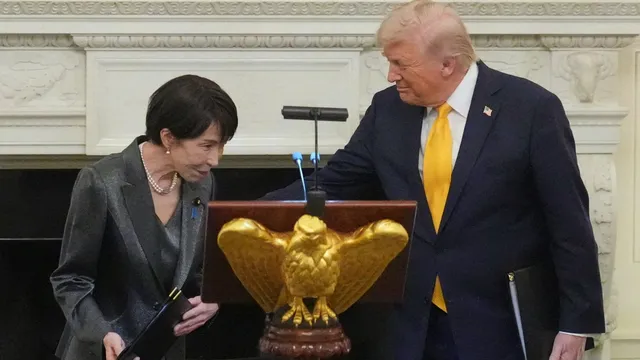
Donald Trump urges Japan to step up naval support in Strait of Hormuz
Donald Trump urges Japan to step up naval support in Strait of Hormuz
- Japanese Prime Minister Sanae Takaichi faces pressure to enhance naval security in the Strait of Hormuz amid Iranian threats.
- Iran's military actions have slowed maritime traffic significantly, impacting global energy supplies, particularly for Japan.
- A political solution is deemed necessary to address the ongoing threats and secure free navigation through this vital shipping route.
Story
Japan has faced pressure from President Donald Trump to enhance its naval presence in the Strait of Hormuz as Iranian threats disrupt oil shipping routes. For weeks, Iranian missile strikes and mine-laying have virtually closed the strait, affecting maritime traffic crucial for global energy supplies. As a response, Japanese Prime Minister Sanae Takaichi acknowledged the need for action to safeguard Japan's energy security but emphasized that any measures would be taken independently of U.S. requests. Japan has historically maintained a pacifist defense posture, making military deployment in a conflict zone a significant shift in its policy. The situation escalated after the war between Iran and other forces entered its third week, resulting in slower traffic and heightened risks for vessels in the region, especially for countries like Japan that depend heavily on oil shipments through the strait. Trump, speaking after a summit with Takaichi, expressed his expectation that Japan would step up, citing the close relationship and the U.S. military presence in Japan as reasons for cooperation. Despite these pressures, Japan has hesitated to commit naval assets due to legal and political implications of entering an active combat zone. Defense experts suggest that actions such as minesweeping could be lower-risk, but sending the Self-Defense Forces into direct conflict remains controversial. The broader implications hinge on whether Japan can balance allied pressure with its domestic constraints and maintain its historical military stance. As the situation evolves, analysts indicate that military solutions are fraught with high risks and low yields, steering the focus toward diplomatic resolutions. The operational capacity to ensure free passage through Hormuz is becoming increasingly challenging due to Iran's asymmetric warfare tactics, which complicate U.S. and allied military responses. Ultimately, the resolution of the strait’s security lies more within the realm of political solutions rather than military might, suggesting a long-term challenge for regional stability.
Context
The energy landscape in Japan has undergone significant changes in recent years, particularly in the wake of the Fukushima Daiichi nuclear disaster in 2011. This catastrophe had far-reaching effects on Japan's energy policies, leading to a marked shift towards increased energy security and diversification of energy sources. As Japan relies heavily on imported fossil fuels to meet its energy demands, it became imperative to develop a comprehensive energy security policy to reduce vulnerability to external shocks, stabilize energy supplies, and promote resilience in its energy infrastructure. Japan's energy security strategy has involved investing in renewable energy, enhancing energy efficiency, and fostering international partnerships for energy procurement and technology transfer. The government has actively encouraged the development of renewable energy sources such as solar, wind, and hydroelectric power. With abundant solar and wind resources, Japan has sought to harness these options to reduce its reliance on fossil fuels and nuclear energy. A key component of this transition is the Feed-in Tariff (FiT) scheme introduced in 2012, which incentivizes the generation of renewable energy through guaranteed payments. This measure has spurred growth in the renewable sector, although it has faced challenges including grid integration issues and the need for further technological advancements. Additionally, Japan has set ambitious targets for renewables to comprise 36-38% of its total power generation by 2030, reflecting a significant commitment to a sustainable energy future. In terms of energy efficiency, Japan has a well-established framework emphasizing the need for energy conservation in both industrial and residential sectors. The government has implemented strict energy efficiency standards for appliances and vehicles, and it actively promotes initiatives for energy saving practices. This comprehensive energy efficiency drive not only aids in achieving climate commitments but also plays a critical role in reducing energy consumption and costs. As part of its broader energy policies, Japan has also focused on smart grid technologies to enhance energy management and allow for better integration of renewable energy sources into the existing grid. In order to bolster its energy security, Japan continues to foster international partnerships that enhance energy procurement stability, including engaging in bilateral and multilateral agreements with resource-rich countries. By partnering with nations rich in natural gas, such as Australia and the United States, Japan aims to secure stable supplies of liquefied natural gas (LNG). Furthermore, Japan is investing in research and development of advanced energy technologies, including hydrogen production and utilization, which holds potential as a clean energy carrier in the future. Through these strategies, Japan is actively working to ensure energy security while transitioning to a more sustainable and diversified energy portfolio.


