politics
impactful
controversial

Putin emphasizes Iran tensions in talks with UAE leader

Jan 29, 2026, 9:50 PM20
(Update: Jan 31, 2026, 5:14 PM)
sovereign state in Southwest Asia
country in Western Asia
capital and most populous city of Russia
sovereign state in Eastern Europe and Northern Asia
president of Russia (1999–2008, 2012–present)
politician
fortified complex in Moscow, Russia

Putin emphasizes Iran tensions in talks with UAE leader

  • Putin indicated interest in discussing Iran tensions with the UAE's leadership during Kremlin talks.
  • The meeting followed the UAE's hosting of peace talks between Russia and Ukraine.
  • This partnership illustrates both nations' strategic interests in a complex geopolitical landscape.
Share your opinion
2

Story

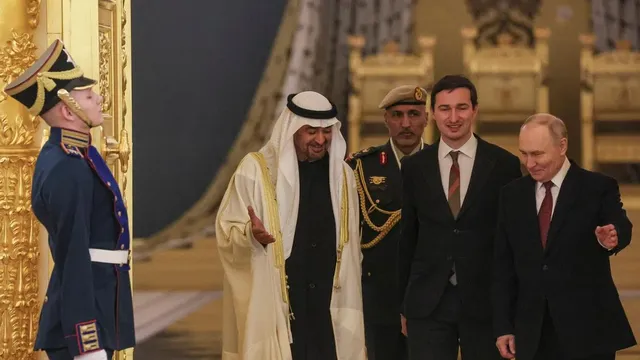
On January 29, 2026, Russian President Vladimir Putin engaged in talks with UAE President Mohammed bin Zayed Al Nahyan at the Kremlin. During these discussions, Putin expressed Russia's concerns regarding the situation in Iran, indicating that he wanted to explore this topic with his UAE counterpart. Earlier that day, Kremlin spokesman Dmitry Peskov commented on the potential for negotiations between the U.S. and Iran, cautioning that military actions could have severe consequences for the region. This meeting follows the UAE's recent facilitation of peace talks between Russia and Ukraine, highlighting its evolving diplomatic role in international affairs. The diplomatic relationship between Russia and the UAE has been strengthening, reflecting shared interests that go beyond ideological alignment. The UAE has become increasingly pivotal in providing a space for dialogue among nations, particularly in sensitive geopolitical contexts. Notably, while the situation in Ukraine remains tense, the UAE has emerged as a venue where discussions can occur without the constraints of overt hostility. It underscores Abu Dhabi’s efforts to consolidate its status as a diplomatic connector amidst rising tensions in the Middle East. Moreover, the UAE has been pursuing a strategy of diversification in its foreign relations to mitigate vulnerabilities that stem from dependencies on any single power. As relations with other regional actors, particularly Saudi Arabia, have become more complex due to competing interests, the UAE's approach to international diplomacy has been to proactively engage with multiple powers, ensuring a balanced portfolio of alliances. This enables it to manage regional challenges while fostering economic and political stability. The engagement between Moscow and Abu Dhabi signals a broader shift in the international order, where both parties are attempting to navigate a multipolar landscape. This partnership is characterized more by pragmatic cooperation than by ideological commitment, as each recognizes their mutual benefits. Russia's framing of its foreign policy reflects a desire for a more balanced international system, while the UAE pursues its national interests through diplomatic finesse and strategic engagements. At this juncture, the discussions about Iran could also affect future collaborative efforts, illustrating the intricate geopolitical dynamics in play.

Context

The United Arab Emirates (UAE) has emerged as a significant player in Middle East diplomacy, capitalizing on its strategic location, economic resources, and a desire to foster stability in the region. Over the past few years, the UAE has actively participated in various diplomatic initiatives aimed at resolving long-standing conflicts and enhancing cooperation among regional actors. Its multifaceted approach combines traditional diplomacy with innovative partnerships, which have often yielded substantial results in addressing complex geopolitical challenges. One of the hallmark achievements of the UAE in recent years has been the normalization of relations with Israel through the Abraham Accords, signed in September 2020. This landmark agreement not only marked a shift in the dynamics of Israeli-Arab relations but also opened avenues for economic cooperation, technological exchange, and security collaboration. By establishing formal ties with Israel, the UAE has positioned itself as a mediator and facilitator in promoting peace and stability in the region, demonstrating its capacity to engage with diverse stakeholders effectively. The UAE's role in the Accords reflects its broader diplomatic strategy to enhance its international standing while actively participating in the resolution of Middle Eastern conflicts. Furthermore, the UAE has played a crucial role in addressing regional crises, including those in Yemen and Libya. In Yemen, the UAE has been involved in the Saudi-led coalition aimed at restoring the internationally recognized government and countering Houthi advances. Through its military and humanitarian efforts, the UAE has sought to stabilize the country while advocating for a political solution to the conflict. In Libya, the UAE has engaged with various factions to promote dialogue, although its involvement has been met with criticism for exacerbating divisions. Despite these challenges, the UAE's diplomatic efforts illustrate its commitment to fostering stability and supporting national reconciliation processes across the region. In recent years, the UAE has also sought to extend its influence beyond its immediate neighborhood by establishing partnerships with global powers and participating in multilateral forums. Its proactive diplomacy has seen it cultivate relationships with countries such as India, Russia, and China, seeking to balance regional interests and attract foreign investment. Through initiatives such as hosting international conferences and contributing to humanitarian efforts worldwide, the UAE has endeavored to enhance its soft power while advocating for a multilateral approach to regional and global challenges. As the landscape of Middle East diplomacy continues to evolve, the UAE's strategic engagements and initiatives will likely remain pivotal in shaping the region's future.

2026 All rights reserved