

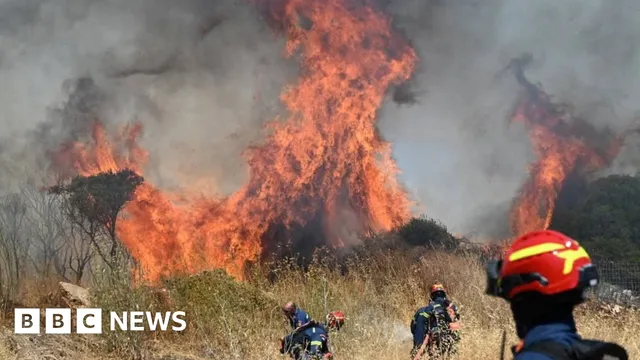
Bradford researchers leverage robotic dogs and AI to combat wildfires
Bradford researchers leverage robotic dogs and AI to combat wildfires
- Researchers at the University of Bradford are testing robotic dogs, drones, and AI for early wildfire detection in Greece.
- The pilot project is part of the EU-funded 6G-VERSUS initiative to explore new technologies in wildfire management.
- This pioneering research aims to enhance wildfire response times and mitigate the increasing threat posed by wildfires.
Story
In an innovative approach to wildfire detection, researchers at the University of Bradford are set to participate in a groundbreaking pilot scheme in Greece next year. This initiative aims to utilize advanced technologies, including robotic dogs, drones, and 6G connectivity, to detect early signs of wildfires. The project is part of the 6G-VERSUS research project, which is funded by the European Union to explore the applications of 6G technology in various sectors. The program not only seeks to enhance the detection capabilities for wildfires but also emphasizes the critical need for timely alerts to emergency teams to mitigate the devastating impact of these events. The increasing frequency and intensity of wildfires globally have prompted a significant response from researchers to tackle this pressing challenge. Dr. Kamran Mahroof, a leading researcher in the project, highlighted the aim of the research is to identify wildfires as early as possible, thus improving the chances of effective intervention. The team’s integration of the latest technological advancements is expected to revolutionize how wildfire risks are monitored and addressed. Specifically, they are leveraging capabilities such as real-time data gathering by robotic dogs to analyze potential fire sources and applying drones for aerial surveillance. In recent years, areas in West Yorkshire, including Marsden Moor and Ilkley Moor, have experienced rising instances of wildfires. This alarming trend has emphasized the need for enhanced firefighting strategies. The West Yorkshire Fire and Rescue Service (WYFRS), although not currently using AI technologies explicitly in their operations, has implemented drones equipped with thermal and optical sensors to assist in real-time monitoring of fire situations. They are also utilizing weather forecasting tools and mapping applications to anticipate fire behaviors more accurately. The collaborative efforts of the University of Bradford and the European Union reflect a growing acknowledgment of the urgent need to innovate in the face of climate change and its effects on wildfire prevalence. As the pilot test in Greece approaches, there is optimism that the results could provide valuable insights that may influence future firefighting technologies and strategies across Europe. The integration of these advanced techniques could serve as a model for addressing wildfires not just locally but globally, thus highlighting the importance of research in combatting environmental crises with cutting-edge solutions.
Context
6G technology is poised to revolutionize emergency services by enhancing communication, data transfer, and coordination during critical situations. As emergency responders face increasingly complex environments, the need for robust and reliable communication systems has never been greater. 6G technology, expected to be fully operational by 2030, offers ultra-low latency, high bandwidth, and massive connectivity, which are essential for delivering timely and accurate information in emergencies. By leveraging advanced wireless networks, emergency services can improve their operational efficiency, ensuring that help arrives quickly and resources are utilized effectively. One of the primary applications of 6G technology in emergency services is in real-time data sharing. First responders can access crucial information such as building schematics, hazard detections, and real-time environmental data directly on their devices. This capability not only speeds up decision-making but also enhances situational awareness. Additionally, through the integration of augmented reality (AR) and virtual reality (VR) technologies powered by 6G, responders can visualize critical information in the field, allowing them to make informed decisions under pressure. Furthermore, cloud-based analytics can process vast quantities of data from various sources, assisting in predicting emergencies and optimizing response strategies. Another essential aspect is the improved interconnectivity between different emergency services, such as police, fire, and medical teams. 6G networks will facilitate seamless communication channels, enabling various agencies to collaborate more effectively during emergencies. Enhanced localization technologies provided by 6G will allow for precise positioning of victims and resources, improving coordination and response time. This integration of services means that responders can share vital information in real time, ensuring a unified response to emergencies which could significantly reduce response times and save lives. Moreover, the implementation of 6G technology can enhance remote capabilities, allowing for drone operations and robotic assistance in危险 environments where human responders may face severe risks. Drones equipped with sensors and cameras can transmit live footage and data back to command centers, offering insights into ongoing situations without putting additional lives in jeopardy. Such advancements emphasize the importance of investing in 6G infrastructure to support emergency services, as the convergence of technology and public safety is crucial for modern society's resilience to disasters and emergencies.


