

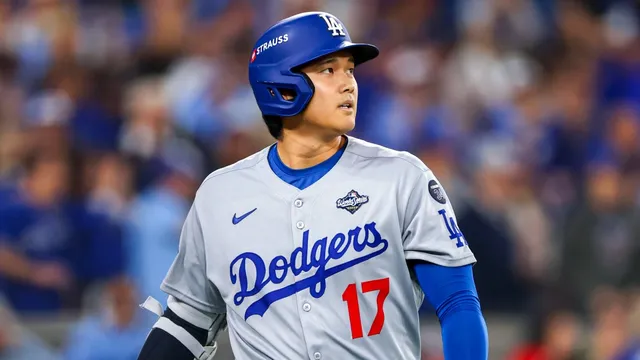
Shohei Ohtani secures fourth MVP award in baseball history
Shohei Ohtani secures fourth MVP award in baseball history
- Shohei Ohtani received the National League Most Valuable Player award on November 14, 2025.
- He became only the second player in MLB history to win four MVP awards, joining Barry Bonds.
- His unanimous win reflects his significant contributions to the Dodgers and the joy he brings to fans in Japan.
Story
In the United States, on November 14, 2025, Shohei Ohtani, the celebrated two-way player for the Los Angeles Dodgers, garnered the National League Most Valuable Player (MVP) award for the fourth time in his career, marking an extraordinary achievement in Major League Baseball history. Ohtani's performance this season was remarkable, contributing significantly to the Dodgers' success and showcasing his exceptional skills as both a hitter and a pitcher. His season statistics included a batting average of .282, leading the National League with a .1.014 OPS, along with hitting 55 home runs and driving in 102 runs while stealing 20 bases. Prior to this impressive accolade, Ohtani's journey in baseball had been nothing short of historic. He previously won the American League MVP award twice while playing for the Los Angeles Angels, solidifying his reputation as a rare talent in the sport. This latest MVP award not only represents his prowess on the field but also underscores his consistent dedication to the game, bringing excitement and accolades not only to his team but also to fans globally. Ohtani's unanimous win further emphasizes his popularity and significance in baseball, as he became only the second player to accumulate four MVP awards, the first being Barry Bonds, who has seven. This achievement sparked celebrations back in Japan, his home country, where the impact of Ohtani's success was widely felt. Following the announcement, extra newspaper editions celebrating his accomplishment were distributed at major train stations, showcasing the pride that Japan has in Ohtani. The excitement surrounding his victories has become an annual ritual, where the country collectively acknowledges his hard work and the motivation he provides to aspiring athletes. Positive responses from Japanese officials and fans echoed the sentiment shared among many who view Ohtani as an exemplary figure in sports. In summary, Shohei Ohtani's recent recognition as the NL MVP further solidifies his legacy as one of baseball's greatest players. His contributions have not only led to personal accolades but have also united fans and raised the profile of baseball, particularly among younger generations. As he continues to lead the Dodgers, excitement builds for future seasons where he can further expand his record and influence in the sport.
Context
The Major League Baseball (MLB) Most Valuable Player (MVP) award is one of the most prestigious honors in professional baseball, recognizing individual excellence in contribution to team success. Since its inception in 1931, the MVP award has evolved, reflecting changes in the league and the game itself. The award is presented annually, typically at the end of the regular season, based on a voting process that includes sportswriters and broadcasters from both leagues. The MVP is chosen based on performance metrics that incorporate offensive and defensive contributions, emphasizing a player's all-around impact on their team and the games played during that season. Throughout its history, the MVP award has seen a rich tapestry of winners, spanning numerous legendary players who have left a significant mark on the sport. Among the most notable winners are Babe Ruth, Ted Williams, Willie Mays, and more recently, players like Barry Bonds and Mike Trout. Bonds holds the record for the most MVP awards, winning seven between 1990 and 2004, while Trout has garnered the award three times before 2023. Each winner's performance is typically highlighted by a combination of statistics, including batting average, home runs, runs batted in (RBIs), and on-base percentages, alongside their leadership and influence in the clubhouse. The selection process for the MVP award is often a subject of debate and scrutiny, with various factors influencing voter decisions. Advanced metrics such as Wins Above Replacement (WAR) and on-base plus slugging (OPS) have increasingly become part of the discussion about a player's value, prompting discussions on how to evaluate player contributions comprehensively. Such metrics aim to provide a more data-driven approach to awards voting, transitioning from traditional statistics to a more holistic view of player performance. Despite changes in evaluation practices, voting controversies continue to arise, frequently revolving around close races and differing voter perspectives on what constitutes 'value.' As the game continues to evolve, the MVP award remains a significant metric of baseball excellence, highlighting the best performances each season. The historical significance of the MVP award not only showcases individual talent but also reflects the changing dynamics of baseball as a team sport. The award's legacy grows as new stars emerge and set new records, while veterans solidify their statuses through outstanding seasons. The story of MLB MVP winners is not just a record of individual accolades; it is a narrative of the game's history, rich with achievements that bind together generations of baseball fans.


