
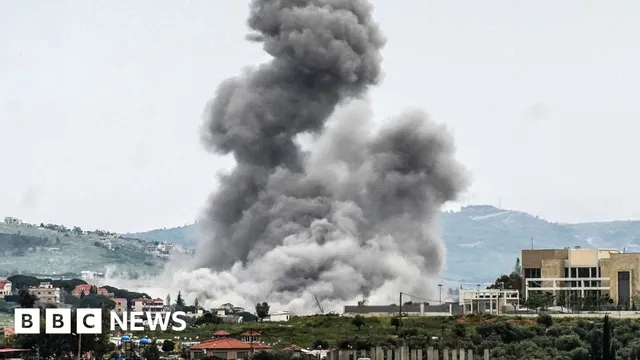
Israel strikes kill 14 amid fragile ceasefire with Hezbollah
- Israeli airstrikes killed 14 people in Lebanon on April 26, 2026, including children and women.
- The strikes were justified by Israel as necessary actions against Hezbollah threats amid a fragile ceasefire.
- The escalating violence reflects ongoing tensions between Israel and Hezbollah, jeopardizing peace negotiations.
Story
On April 26, 2026, Israeli airstrikes targeted southern Lebanon, resulting in the deaths of 14 individuals, including two children and two women, as reported by Lebanon's Ministry of Health. This escalation occurred during a precarious ceasefire that was extended by the US just a few days prior, from an initial agreement established on April 16, which aimed to curtail violence between Israel and Hezbollah. The Israeli Defense Forces (IDF) claimed these strikes were aimed at Hezbollah operatives and infrastructure used for attacks against them. In a related incident, a Hezbollah drone attack in Lebanon resulted in the death of a 19-year-old IDF soldier and injured six others, further intensifying tensions in the region. In response to these attacks, the IDF issued evacuation warnings for villages near the border and conducted additional strikes targeting Hezbollah military sites, emphasizing their right to defend against threats. Israeli Prime Minister Benjamin Netanyahu reaffirmed the military's active role and the need to respond to Hezbollah's actions, which he claimed were undermining the ceasefire. This volatile situation is exacerbated by repeated exchanges of aggression between both parties since the onset of the ceasefire, with each side accusing the other of violations. Amidst these developments, Iran's Foreign Minister Abbas Araghchi engaged in discussions aimed at resuming peace negotiations with the United States, leaving the regional situation complex and fraught with uncertainty.
Context
The history of Israel-Lebanon ceasefire agreements is marked by a series of negotiations, conflicts, and attempts at establishing lasting peace in a region characterized by tension and hostility. Since the mid-20th century, both Israel and Lebanon have been involved in numerous confrontations, most notably during the Lebanese Civil War and subsequent conflicts involving various Lebanese factions, including Hezbollah. The complexity of the situation is further complicated by the involvement of regional and international powers, which have influenced the course of negotiations and ceasefires. The initial attempts at ceasefire came in the wake of the 1978 Israeli invasion of Lebanon, which was followed by the United Nations Security Council Resolution 425 aimed at establishing peace and security in the region. However, this resolution did not lead to a long-lasting ceasefire as hostilities continued, leading to further military engagements in the years that followed. In 1982, Israel launched a full-scale invasion of Lebanon, aiming to dismantle the Palestine Liberation Organization (PLO) presence in the country. The aftermath of this invasion resulted in the 1983 Lebanon-Israel Agreement, which, despite initial hopes, failed to achieve a robust and sustainable peace. The situation worsened as Hezbollah emerged as a significant force opposing Israeli presence, and by 1985 when Israel withdrew from most of Lebanon but retained a security zone in the South, periodic clashes continued, disrupting the fragile peace. Various UN resolutions were proposed throughout the 1990s, culminating in the 1996 "Grapes of Wrath" operation, during which the UN brokered a ceasefire agreement that sought to end hostilities between Israel and Hezbollah. Although this ceasefire temporarily reduced violence, it did not resolve the underlying issues. The deterioration of the security environment led to the 2006 Lebanon War, a conflict that resulted in significant casualties and destruction. In response, the UN Security Council adopted Resolution 1701, which mandated a ceasefire and sought to establish peacekeeping forces in the region to monitor the cessation of hostilities and facilitate humanitarian assistance. Despite the resolution, skirmishes continued, and tensions remained high, making it evident that a long-lasting peace agreement was still a distant prospect. Both parties have engaged in sporadic discussions in the years following the 2006 conflict, yet no comprehensive treaty has been achieved, largely due to deep-rooted historical grievances and ongoing territorial disputes, particularly regarding the Shebaa Farms area. The challenges surrounding ceasefire agreements between Israel and Lebanon reflect not only the political and military dynamics but also the national narratives and identities that both nations hold. As history shows, each attempt at negotiating a ceasefire has been accompanied by shifts in the geopolitical landscape, regional power dynamics, and domestic considerations affecting both Israel and Lebanon. The situation remains fragile, with periodic escalations in violence that underscore the precarious nature of the ceasefire agreements implemented thus far. For a sustainable peace, it is crucial for both societies to engage in meaningful dialogue and reconciliation aimed at addressing the root causes of their longstanding conflict; however, given the complexity and volatility of the region, this remains an arduous and uncertain endeavor.
