

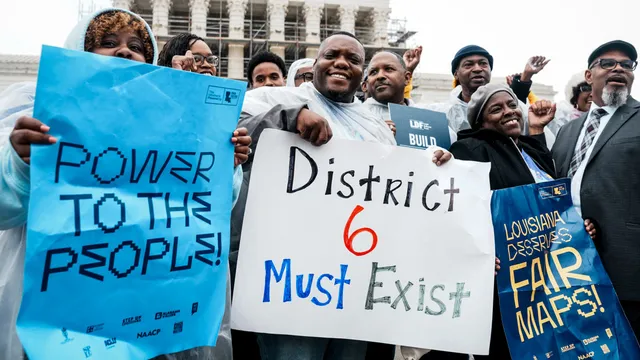
Louisiana GOP advances map to eliminate Democratic House seat
Louisiana GOP advances map to eliminate Democratic House seat
- The new congressional map proposed by Louisiana Republicans would shift the party's representation from 4-2 to 5-1.
- This change comes after the Supreme Court ruled the previous map unconstitutional due to racial gerrymandering.
- The decision has sparked tensions among lawmakers and raised concerns regarding the disenfranchisement of Black voters.
Story
In Louisiana, Republicans in the state Senate voted to advance a new congressional map designed to solidify their advantage in the House of Representatives. This decision emerged following a Supreme Court ruling which struck down the previous map due to unconstitutional racial gerrymandering. The new district lines would shift the representation from 4-2 in favor of Republicans to a 5-1 ratio, effectively eliminating one of Louisiana's two majority-Black districts, which has raised concerns among Democratic leaders about misrepresentation and disenfranchisement of Black voters. The current map could potentially displace Democratic Representative Cleo Fields. In light of these changes, tensions have escalated in Baton Rouge as Democrats criticize the redistricting as a strategic effort to minimize Black representation in Congress. Lawmakers had previously rejected alternative proposals that would maintain both Democratic districts, indicating a clear intent to prioritize partisan gains over fair representation. The recent legal developments have resulted in significant political shifts, aiming to strengthen Republican control of congressional seats in Louisiana. The 5-1 map reflects an increasing trend among southern states to adjust congressional lines to favor Republicans, following court decisions that have altered the landscape of redistricting in the wake of the Voting Rights Act. As the legislature navigated this contentious redistricting process, frustrations were palpable among Democrats, particularly in the aftermath of a Supreme Court decision that changed the criteria for drawing districts. This ruling removed the obligation to create districts that provide minority voters with proportional representation, prompting southern states to act swiftly in restructuring districts that traditionally supported Democratic candidates. Every alteration to the congressional maps not only affects local representation but also significantly impacts the broader control of the House of Representatives. With the upcoming midterms in November, Republicans are motivated to solidify their dominance by altering electoral maps to meet their strategic goals. The urgency of these changes highlights the constant battle over voter representation and districting in the political arena. Democrats, facing a more difficult path to reclaiming the House, have vowed to fight back against these developments and advocate for more equitable representation. The discussions surrounding redistricting promise to shape the electoral landscape significantly heading into the next election cycle and beyond.
Context
The Louisiana Supreme Court's recent decision on redistricting is a significant event in the state's political landscape, bringing attention to the complexities of electoral representation and demographic changes. Redistricting typically occurs every ten years, coinciding with the national census, and is critical for ensuring that districts accurately represent the populations they serve. The implications of this case extend beyond the immediate adjustments of district lines; they touch on broader themes of fairness, equity, and political power in a state with a diverse demographic makeup. As such, the court's ruling is set against a backdrop of ongoing discussions regarding racial representation and the effective enfranchisement of all citizens. In this particular case, the Louisiana Supreme Court assessed the constitutionality and legality of the redistricting maps proposed by the state legislature, focusing on whether these maps adequately reflected the state's population distribution and respected the Voting Rights Act. Critics of the proposed maps argued they disproportionately diluted the voting power of minority groups, particularly African American voters, and failed to create sufficient majority-minority districts despite significant demographic shifts. The court's decision ultimately played a crucial role in determining how well these maps aligned with both state and federal legal standards, as well as the intent behind providing equitable representation. The ruling's timing is especially pertinent, given the approaching elections and the immediate impacts on candidates, voters, and political parties in Louisiana. The Supreme Court acts as the final arbiter in disputes surrounding redistricting, which underscores the importance of judicial intervention in safeguarding democratic processes. As politics in Louisiana continue to evolve, the court's decision not only shapes the electoral landscape for upcoming cycles but also sets a precedent for how legislative bodies approach redistricting in the future. The balancing act between political interests and fair representation is delicate, and the court's ruling reflects a commitment to upholding democratic principles, ensuring that every vote holds weight. As Louisiana moves forward from this ruling, the implications will resonate for years to come. Engaging communities in the electoral process and fostering a greater understanding of how redistricting affects political power will be essential in promoting a healthy democratic system. Furthermore, ongoing monitoring of the enacted district maps will be necessary to guarantee compliance with legal standards and to assess their impacts on future elections. In sum, the Louisiana Supreme Court's decision on redistricting is a pivotal moment that highlights both the challenges and necessities of maintaining fair and equitable political representation in a rapidly changing demographic landscape.


