
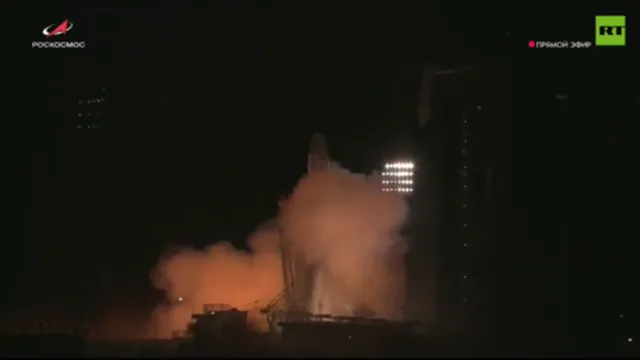
Roscosmos successfully launches Elektro-L No.5 weather satellite into orbit
- Roscosmos launched the Elektro-L No.5 weather satellite using a Proton-M rocket from the Baikonur Cosmodrome.
- The launch occurred at 11:52 AM Moscow time and marked the 430th launch in the Proton rocket series.
- This satellite enhances weather forecasting and joins three existing satellites to provide continuous coverage of Earth.
Story
In Kazakhstan, on February 9, Russia's Roscosmos executed a significant space mission by launching a Proton-M rocket that successfully transported the Elektro-L No.5 weather satellite into geostationary orbit. The launch took place from the Baikonur Cosmodrome at precisely 11:52 AM Moscow time. This event marked a pivotal moment in the 430-launch history of the Proton rocket series, which began over six decades ago. The Proton-M, which stands 57.6 meters tall and has a total mass of 705 tonnes, is a three-stage heavy-lift vehicle designed to send large payloads into orbit. The Elektro-L No.5 is part of a modern series of meteorological satellites that aim to provide comprehensive imagery of the Earth from approximately 35,000 kilometers above the surface. The satellite is capable of delivering images in visible and infrared bands, boasting a resolution of 1 and 4 kilometers per pixel. With the provision of round-the-clock data, it is expected to enhance services in weather forecasting, sea and ocean monitoring, aviation safety, and scientific studies concerning the ionosphere and Earth's magnetic field. Additionally, the satellite plays a role in the international Cospas-Sarsat search-and-rescue system, thus serving both civil and humanitarian purposes. The launch culminated a lengthy preparation process, which included a two-month delay due to a detected non-conformity in the rocket's upper stage during pre-flight inspections. Originally scheduled for December, the mission was pushed back, allowing Roscosmos to complete necessary corrections. The Elektro-L No.5 joins a fleet of three other active satellites from the same series, all equipped with a 120-degree field of view, providing continuous full-disc coverage of the Earth. With a designed operational lifespan of at least ten years, the new satellite is positioned to play a crucial role in meteorological advancements for the foreseeable future. This successful launch supported ongoing trends in satellite technology development and the increasing complexity of space missions. The growing number of satellites in geostationary orbit promises not only to enhance meteorological data acquisition but also serves as a testament to Russia's commitment to maintaining its status as a key player in the global space industry. The continual advancements in technology, such as improvements in resolution and data transmission, further emphasize the importance of such missions in understanding and responding to global environmental challenges.
