

Military-backed party claims victory in Myanmar's sham elections
Military-backed party claims victory in Myanmar's sham elections
- The Union Solidarity and Development Party (USDP) won a significant majority in the first phase of the 2023 Myanmar elections.
- Only 52% of eligible voters participated, indicating a decreased interest compared to previous elections.
- Critics argue that the election is a facade to legitimize military rule amid ongoing civil unrest.
Story
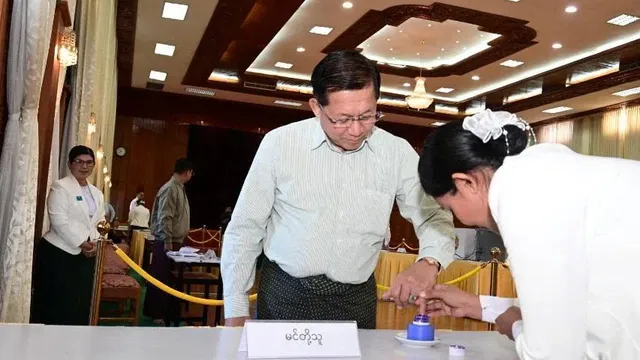
Myanmar's military-backed Union Solidarity and Development Party (USDP) has emerged victorious in the first phase of a three-part general election held on December 28, 2023. Early results, released by state media and the Union Election Commission, indicated that the USDP won 38 out of 40 contested seats in the Lower House, also known as the Pyithu Hluttaw. Despite a nationwide rebellion following the military coup in February 2021, the junta has positioned the election as a pathway to political stability. Critics have denounced the elections as a sham, highlighting the absence of anti-junta political parties and the illegality of criticizing the polls. The USDP, led by retired generals, also claimed victories in most contested regional seats, even though voter turnout was reported at just 52%, significantly lower than previous elections in 2015 and 2020, which saw approximately 70% turnout. This disappointing turnout reflects public dissent and a boycott called by various opposition groups against the legitimacy of the election process. Voting took place only in 102 out of 330 townships in Myanmar due to ongoing armed conflicts, with subsequent phases of voting planned for January 11 and January 25, 2024. Reports suggested that the military government exerted considerable pressure on the electorate to participate. The election has been condemned by international observers, including the United Nations and human rights organizations, which argue that the lack of competition and the forced participation undermine the credibility of the election outcomes. Aung San Suu Kyi, the deposed leader, remains detained, and her National League for Democracy has been dissolved under the new military rules. Analysts predict that gaining foreign recognition for any military-controlled government will be difficult, given the current civil conflict and the junta's questionable legitimacy. The military retains a constitutional right to a 25% allocation of legislative seats, which complicates any future governance by the USDP or other parties. The election outcomes, amid ongoing civil unrest, suggest that achieving peace and stability in Myanmar is fraught with challenges; the junta seeks to maintain its hold on power while suppressing dissent. Expert opinions in the aftermath indicate that the military's need for a veneer of legitimacy may drive further unrest and calls for international intervention. As complete results remain undisclosed, uncertainties linger regarding the electoral process's overall integrity, further complicating the country's political landscape as it strives to emerge from the depths of turmoil caused by the coup and ongoing civil war.


