

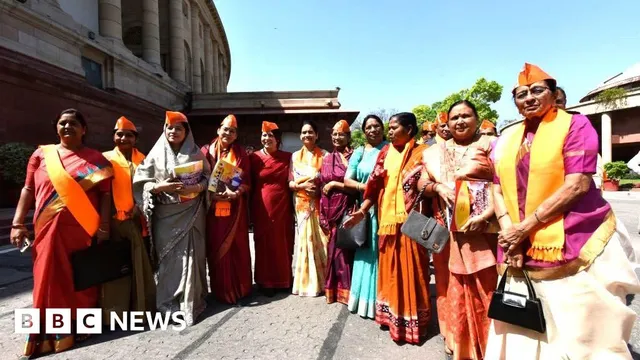
India seeks to redraw political map for women's representation
India seeks to redraw political map for women's representation
- India's government proposes reforms to increase women's representation in parliament by reserving one-third of seats.
- The plan involves a redrawing of electoral boundaries according to the 2011 census, potentially expanding the lower house to about 850 seats.
- Concerns from southern state leaders highlight the risk of unequal seat distribution, raising questions about representation.
Story
In India, the government has initiated a significant move to redraw the political landscape, which aims to reserve one-third of parliamentary and state assembly seats for women. This historic reform is associated with the need for a population-based redrawing of electoral constituencies in light of the 2011 census data. Currently, the parliament consists of 543 seats, but the proposed plan would increase this number to about 850. Prime Minister Narendra Modi advocated for this initiative, emphasizing the importance of women's representation and urging political parties not to politicize the reforms. Despite the intent to empower women in politics, several concerns have emerged from state leaders, particularly in southern regions, about the potential negative impacts of this restructuring on their political power, driven by differing population growth rates across states. Southern states, including Tamil Nadu, Kerala, Karnataka, and Telangana, have requested a freeze on the redistribution of electoral seats to protect their interests. Critics argue that while no state would technically lose seats under the new proposal, the lack of a clear proportional formula could advantage more populous states. This could lead to disparities in representation, raising questions about which states might eventually gain more seats in the parliament. Furthermore, there remain unanswered questions regarding how the new parliamentary seats for women would be allocated, especially considering the ongoing reservations for Scheduled Castes (SC) and Scheduled Tribes (ST). In the context of the political landscape, there are multiple stakeholders involved, including the opposition, which is contesting the speed and timing of the proposals being introduced in the midst of an election season. Opposition leaders have expressed concerns that the proposed changes are politically motivated. A think tank member has pointed out discrepancies in the rationale for the expanded number of seats when juxtaposed against population growth from previous censuses. Effective advocacy and debates around these issues indicate that while the government's intentions may align with modernizing representation and ensuring gender equality, the implications of this change could substantially reverberate across India's election dynamics. Given these unfolding events, the discussion surrounding women's representation in Indian politics has gained urgency. The government asserts that postponing the implementation of these reforms would only delay much-needed progress in gender equality, especially within the political domain. This ongoing debate highlights the complexities surrounding electoral reforms and women's empowerment in a culturally diverse society, where political stakes can significantly vary by region. The delicate balancing act between empowering women and ensuring fair representation across different states is likely to continue as the proposals move forward.


