

Tragic UPS plane crash kills 14 after engine falls off during takeoff
Tragic UPS plane crash kills 14 after engine falls off during takeoff
- On November 4, 2025, a UPS cargo plane crashed shortly after takeoff from Louisville airport.
- The accident resulted in 14 fatalities and numerous injuries, prompting an urgent review of safety regulations.
- Federal authorities have grounded all McDonnell Douglas MD-11 planes until further inspections are completed.
Story
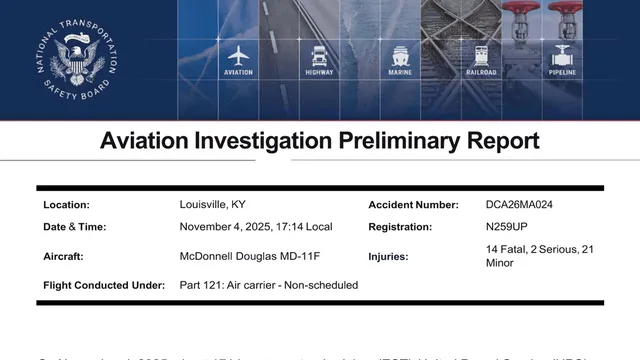
On November 4, 2025, a tragic incident occurred at Louisville Muhammad Ali International Airport in Kentucky, USA, involving United Parcel Service (UPS) flight 2976. The Boeing McDonnell Douglas MD-11F, registered as N259UP, took off around 1714 EST when the left engine and pylon assembly detached from the wing shortly after liftoff. The aircraft was headed to Daniel K. Inouye International Airport in Honolulu. In the accident, 14 lives were lost, including three crew members on board and 11 people on the ground, with 23 additional injuries reported. Preliminary investigations by the National Transportation Safety Board (NTSB) indicated that metal fatigue cracks around the engine were contributing factors to the structural failure. Photographs from airport surveillance captured the moment the left engine separated from the aircraft, igniting a fire that quickly consumed the plane. As the aircraft reached only about 30 feet altitude, it crashed in a ball of flame, impacting a storage yard and two buildings adjacent to the airport, highlighting the devastating nature of the accident. Following the accident, federal authorities acted swiftly to preserve public safety by prohibiting all operators of McDonnell Douglas MD-11 planes from flying until thorough inspections were conducted. This emergency directive arose from concerns regarding the integrity of these aircraft's engine mount assemblies, which have been under scrutiny due to the incident. The last inspection of the affected components occurred in October 2021, with the next scheduled inspection set for after the aircraft completed 28,000 flights. The flight in question had already completed over 21,000 flights, raising alarms about the inspection schedules for older aircraft. This incident drew comparisons to a similar crash involving an American Airlines flight in 1979, which killed over 270 people after a part failure during takeoff. The ongoing investigation aims to determine the exact cause of the detachment, focusing on manufacturing standards, maintenance practices, and oversight by regulatory bodies. As the aviation community grapples with the implications of this disaster, safety measures and inspection protocols for cargo aircraft are likely to undergo significant reviews and modifications to prevent such tragedies in the future.
Context
The impact of aviation safety regulations following plane crashes is a critical area of study, as it sheds light on how regulatory frameworks evolve to enhance passenger safety and mitigate future incidents. Historically, significant aviation accidents have prompted regulators, such as the Federal Aviation Administration (FAA) in the United States and the European Union Aviation Safety Agency (EASA), to reevaluate and often tighten safety protocols. These regulations typically focus on various aspects including aircraft design, pilot training, maintenance procedures, and operational practices. Each major crash often acts as a catalyst for legislative change, emphasizing the necessity for continuous monitoring and adaptation to new safety challenges in the aviation industry. After a notable plane crash, investigations conducted by organizations like the National Transportation Safety Board (NTSB) lead to findings that inform regulatory revisions. Recommendations stemming from these investigations often address specific deficiencies that contributed to the accident. For example, if a malfunction in a critical system is identified as a cause, regulations may be implemented to require more rigorous testing of that system in all aircraft. This regulatory process is vital because it not only aims to rectify identified issues but also proactively seeks to prevent similar accidents from occurring in the future based on learned experiences. In addition to design-related changes, regulations may also emphasize enhanced training for aviation personnel. Crashes have revealed that human factors, such as pilot error or miscommunication, can significantly impact safety. Consequently, aviation safety regulations often include mandates for improved pilot training programs that focus on situational awareness, decision-making under pressure, and crisis management. Insights drawn from flight data and cockpit voice recorders provide critical data that shapes these training enhancements, ensuring that pilots are better equipped to handle unforeseen circumstances. Furthermore, monitoring the effectiveness of new regulations post-implementation is essential for ongoing safety improvements. Aviation authorities continuously analyze accident statistics and safety reports to assess the impact of regulatory changes. This cycle of investigation, regulation, implementation, and analysis ensures that the aviation industry does not only react to past incidents but also proactively fortifies itself against potential risks. Overall, the development and revision of aviation safety regulations, driven by the lessons learned from plane crashes, are fundamental to improving the safety record of air travel and protecting the lives of passengers and crew alike.


