

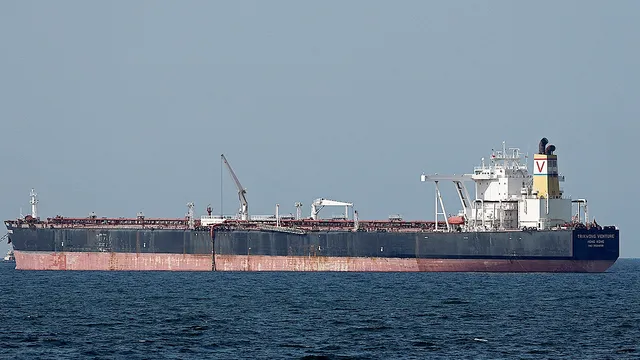
Russia executes covert oil transfer worth $29 million amid sanctions
Russia executes covert oil transfer worth $29 million amid sanctions
- The Russian tanker M/V TRUST has been implicated in a covert oil transfer operation in the Gulf of Oman, carrying 325,000 barrels of crude oil.
- This operation utilized a strategy that included partial AIS transmission, which complicated tracking efforts during a time of geopolitical instability.
- Despite U.S. and Western sanctions, Russia continues to export significant quantities of oil to nations like China and India, indicating enforcement challenges.
Story
Russia has been using its so-called 'shadow fleet' for illicit oil transfers to circumvent Western sanctions imposed after its invasion of Ukraine. Recently, an operation involving the Russian-flagged tanker M/V TRUST was reported, which executed a 'semi-dark' ship-to-ship transfer of approximately 325,000 barrels of crude oil in the Gulf of Oman, worth about $29.3 million. This transfer occurred during a period of heightened military tensions in the region, indicative of the broader geopolitical instability. The tanker involved had previously been blacklisted by various Western nations, emphasizing the ongoing enforcement challenges these sanctions face. Maritime intelligence firms such as Windward AI highlighted the tactics employed during the covert operation, which included having one vessel (M/V TRUST) transmit its Automatic Identification System (AIS) signal while the other did not. This created partial visibility, making it harder to track the actual cargo transfer. The ongoing conflict in the Middle East, particularly the military actions involving U.S. and Israeli strikes against Iran, has further complicated navigation and shipping dynamics in the critical Strait of Hormuz, a strategic passageway for oil transportation. Despite the sanctions designed to destabilize Moscow's economy by targeting its oil industry, Russian crude oil continues to reach markets, particularly in nations like China and India. Analysis from the Centre for Research on Energy and Clean Air (CREA) revealed that from February 2025 to February 2026, sanctioned tanker vessels shipped over $11 billion of Russian oil across numerous voyages, with China accounting for a significant portion of that import. This suggests that the sanctions have not effectively crippled Russia's oil revenue as intended, revealing serious loopholes in enforcement which allow these illicit activities to persist. In the context of the escalating situation within the Gulf, tensions remain high with fears of potential disruptions to global energy supplies. On March 9, oil prices surged over $100 a barrel as traders reacted to threats against shipping and the uncertainty created by military operations. Russian President Vladimir Putin has expressed a willingness to resume long-term energy cooperation with European customers, signaling an ongoing strategy to retain market access despite international opposition. This complex interplay of geopolitics, economic sanctions, and maritime operations creates significant challenges for energy security and international trade.
Context
The impact of US sanctions on Russian oil exports has been significant and multifaceted, influencing both the Russian economy and global energy markets. Following the imposition of sanctions in response to geopolitical tensions, particularly after the events of 2014 in Ukraine, the Russian oil sector faced substantial challenges. The sanctions targeted key areas, including financial transactions, technology transfers, and oil production capabilities, which hindered Russia's ability to develop new oil projects and maintain its existing infrastructure. As a result, production levels have fluctuated, and the country has struggled to find alternative markets and financing to sustain its oil exports. This has placed considerable strain on an economy heavily reliant on its oil revenues, causing GDP growth to stagnate and increasing economic uncertainty in the region. In response to the sanctions, Russia has sought to diversify its oil export markets, pivoting towards countries less affected by Western restrictions. This shift has included strengthening ties with countries in Asia, particularly China and India, as well as exploring new trade agreements within the framework of organizations such as OPEC+. Despite these efforts, the effectiveness of these strategies has been inconsistent, as Russia's primary oil export infrastructure remains oriented toward European markets. Furthermore, the global oil landscape has also evolved, with competing oil-producing nations adjusting their output and prices in reaction to changes in demand and geopolitical tensions, further complicating Russia’s ability to navigate sanctions successfully. The price of oil is a crucial determinant of the economic fallout from sanctions on Russian exports. Volatility in global oil prices has impacted Russia’s economy, with periods of high prices providing some relief, while slumps in oil prices have exacerbated the negative consequences of sanctions. In addition to direct impacts on revenues, the sanctions have also fostered an environment of financial isolation for Russia, limiting access to critical technology and investment that is essential for exploring and producing oil effectively. Continued sanctions are likely to create long-term changes in the operational capabilities of Russian oil companies, potentially leading to decreased production efficiency and output in the years to come. Ultimately, the consequences of US sanctions on Russian oil exports illustrate the complex interplay between national security, economic strategy, and global energy policies. As these sanctions persist, their ripple effects are likely to influence not just Russia but also broader geopolitical dynamics. Countries dependent on Russian oil imports will need to reassess their energy strategies in light of these ongoing sanctions, prompting global shifts in energy consumption patterns. Understanding these impacts is vital for policymakers and stakeholders in the energy sector, as they navigate an increasingly intricate landscape shaped by both domestic priorities and international relations.


