

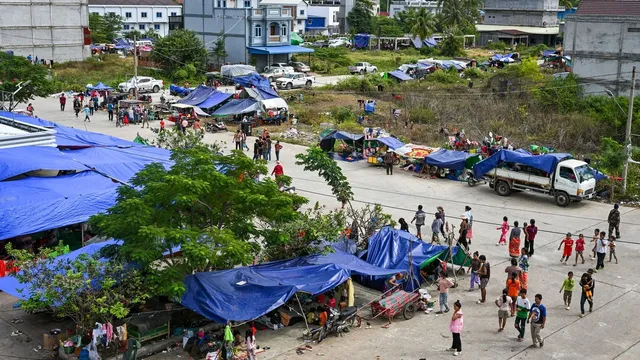
Hundreds of thousands flee as Thailand and Cambodia clash again
Hundreds of thousands flee as Thailand and Cambodia clash again
- Renewed fighting between Thailand and Cambodia has displaced around 400,000 people in Thailand and over 127,000 in Cambodia.
- Evacuation warnings enabled many individuals to flee before the fighting intensified, leading to accommodations in makeshift shelters.
- The ongoing conflict raises concerns about the future of peace in the region and the welfare of those affected.
Story
In recent days, renewed fighting along the Thailand-Cambodia border has led to a significant humanitarian crisis, with reports of about 400,000 people displaced from their homes in Thailand as well as over 127,000 in Cambodia. The conflict erupted after a brief skirmish on a Sunday, which was accompanied by evacuation warnings that prompted many residents in northeastern Thailand to leave their homes in advance of a potential escalation in violence. Evacuees have taken shelter in various makeshift accommodations, including university halls and gymnasiums, where conditions have been reported as strained yet bearable for many. The Thai military has closed around 700 schools in the affected areas, as families grapple with the uncertainty of their displaced status. Local officials have been providing emergency assistance, including food and psychological support, but the psychological toll on those forced to flee their homes is considerable. The backdrop of this renewed violence is a historical territorial dispute between the two nations, compounded by national sentiments and military posturing from both sides. Thailand's Prime Minister Anutin Charnvirakul has vowed to continue military operations, while Cambodia's Senate President Hun Sen promised a fierce response to any aggression. The situation remains imperative, as families contend with the severe limitations of their temporary living conditions while longing for safety and the opportunity to return home. Additionally, there is growing international concern regarding the viability of peace in the region, especially after past diplomatic efforts, including a ceasefire brokered by U.S. President Donald Trump, were undermined by a return to active conflict. The local populations are now left to navigate the challenges of survival, reflecting a breadth of emotional anguish as they worry about their homes, livelihoods, and pets left behind in the chaos of sudden evacuation.
Context
The ongoing conflict between Thailand and Cambodia has deep historical roots that can be traced back to territorial disputes, nationalism, and colonial legacies. The most notable source of tension between the two countries has been the ownership of the Preah Vihear Temple, a UNESCO World Heritage site located on a cliff in the Dângrêk Mountains. The temple has significant religious and historical importance for both nations and has fueled nationalistic sentiments over the years. In 1962, the International Court of Justice ruled that the temple belonged to Cambodia, but the surrounding area remained a subject of contention, leading to increased military presence on both sides of the border. In addition to the Preah Vihear Temple, the two countries have experienced numerous skirmishes and military standoffs, particularly in the border regions rich in natural resources. These disputes have been exacerbated by internal political challenges within both nations, where leaders have often used nationalist rhetoric to rally support and distract from domestic issues. The rivalry between the two countries reached its peak in 2008, when the Cambodian government sought to promote the Preah Vihear Temple as a national symbol, leading to heightened tensions and border clashes that resulted in casualties on both sides. Diplomatic efforts to resolve these conflicts have often been undermined by the complex interplay of national identity, sovereignty, and local interests. In attempts to mediate the ongoing conflict, various ASEAN (Association of Southeast Asian Nations) frameworks have been proposed, yet progress has been slow. The Thai-Cambodian border has seen periods of relative calm interspersed with flare-ups, with periods of military confrontation often correlating with political instability in either country. To further complicate the situation, the involvement of external powers and regional dynamics has often influenced the conflict, with both countries seeking to assert their influence in the region through alliances and partnerships. This geopolitical aspect adds another layer of complexity to the territorial disputes, making resolution increasingly difficult. Despite the historical grievances and ongoing disputes, there have been some positive signs toward reconciliation. Bilateral discussions have resumed intermittently, with both governments expressing an interest in fostering better relations and cooperation on security and economic issues. However, deeply entrenched nationalism and mutual distrust remain significant barriers to a peaceful resolution. Both Thailand and Cambodia will need to prioritize dialogue and diplomacy over military confrontation if they hope to find a lasting solution to their border conflicts, which continue to pose risks to regional stability and cooperation.


