

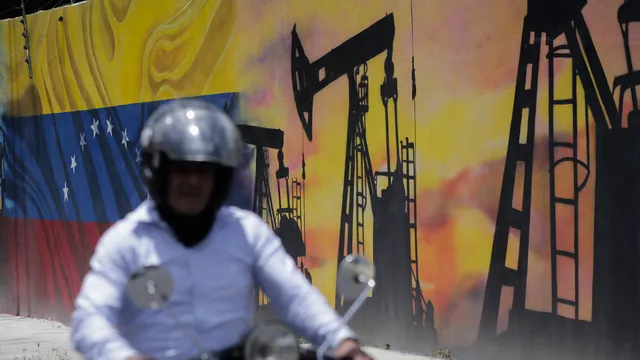
Chevron stays in Venezuela as Trump encourages U.S. energy firms to invest billions
Chevron stays in Venezuela as Trump encourages U.S. energy firms to invest billions
- Chevron is currently the only U.S. oil company operating in Venezuela amid uncertainties regarding other firms' return.
- The Trump administration believes there's potential for U.S. energy firms to invest heavily in revitalizing Venezuela's oil infrastructure.
- The overall sentiment is that without significant governance changes, the sanctions on Venezuela's oil will remain enforced, thus limiting international investment.
Story
Venezuela, which holds the world's largest oil reserves, has experienced a significant decline in its oil industry due to years of neglect and mismanagement. As of 2023, President Donald Trump suggested that U.S. energy firms could return to Venezuela to repair its broken oil infrastructure and revitalize the economy. While Chevron continues to operate in Venezuela under a special license, neither ConocoPhillips nor ExxonMobil, the largest U.S. oil company, have publicly committed to a return, reflecting uncertainty among American companies regarding the political and regulatory environment. Trump has indicated that U.S. companies could invest billions to unlock Venezuela's oil wealth, aiming to sell oil to various countries. The Venezuelan government's nationalization campaign in the past has led to a significant withdrawal of foreign oil companies, particularly during Hugo Chávez's presidency, which resulted in a chronic underinvestment in the oil sector. This situation gave rise to a dilapidated infrastructure where oil production is vastly below potential, with many fields operating at less than 20% capacity due to outdated equipment and invasive operations. Moreover, Secretary of State Marco Rubio has expressed confidence about the interest from Western oil companies to return to Venezuela, emphasizing the necessity of altering governance in the oil sector before the sanctions on Venezuelan oil can be adjusted. He highlighted the current environment as being filled with pirate-like operations, where oil is stolen rather than produced through legitimate means. This has led to an insignificant benefit for the Venezuelan population from its abundant natural resources, further deepening the economic issues in the country. The U.S. administration retains strict sanctions to ensure that no sanctioned oil enters the market, citing a clear strategy focused on improving governance within Venezuela. Rubio's remarks about the need for private industry involvement underscore a broader discussion on how foreign investment could potentially reconstruct the country's oil infrastructure and improve living conditions for the Venezuelan population, contingent on substantial reforms.
Context
The history of Venezuela's oil industry nationalization is a complex narrative intertwined with the country’s economic, political, and social fabric. The development of the oil sector in Venezuela can be traced back to the early 20th century, when the discovery of oil sparked significant foreign investment, primarily from American and European companies. By the 1920s and 1930s, Venezuela had emerged as one of the world’s leading oil exporters, but this growth led to increasing unease among the Venezuelan populace regarding the substantial profits being repatriated by foreign firms, while the nation itself struggled with poverty and underdevelopment. This discontent laid the groundwork for subsequent nationalization efforts that would reshape the oil industry and the Venezuelan economy at large. Nationalization became a critical issue in the 1950s and 1960s as nationalist sentiments grew. The election of President Rómulo Betancourt in 1958 marked a pivotal moment in Venezuela's oil history, promoting policies that aimed at increasing government control over oil resources. After years of negotiations and tensions with foreign oil companies, the government implemented reforms that eventually led to the full nationalization of the industry in 1976. The expropriation was formalized under the creation of Petróleos de Venezuela, S.A. (PDVSA), which was established to manage the country’s oil resources. The nationalization aimed not only to boost state revenues but also to ensure that profits from the oil industry served the Venezuelan population, addressing historical inequalities exacerbated by foreign ownership. Despite its initial success in increasing state revenues and funding social programs, the nationalization of Venezuela's oil industry also brought significant challenges. In the decades following nationalization, the petroleum sector faced numerous issues, including mismanagement, corruption, and a lack of investment in infrastructure and technology. These problems were compounded during periods of political instability and economic volatility, particularly during the leadership of Hugo Chávez, who escalated government intervention in the industry and took a hardline stance against foreign oil companies. Chavez's policies, while appealing to the marginalized sectors of society, often alienated international investors and led to sanctions and a decline in oil production capacity. As Venezuela entered the 21st century, the consequences of the nationalization and subsequent policies became more apparent. The dependence on oil revenues to fund government operations left the economy vulnerable to fluctuations in oil prices. Moreover, political actions taken by subsequent governments, particularly under Nicolás Maduro, have further entrenched the challenges faced by the oil industry. The consequences of decades of economic mismanagement have resulted in a dramatic decline in oil production and severe economic hardship for the country. Thus, while the agenda of nationalization aimed to restore Venezuelan sovereignty over its natural resources, the path forward for the oil industry remains fraught with challenges, which continue to impact the nation’s geopolitical and economic landscape.


