
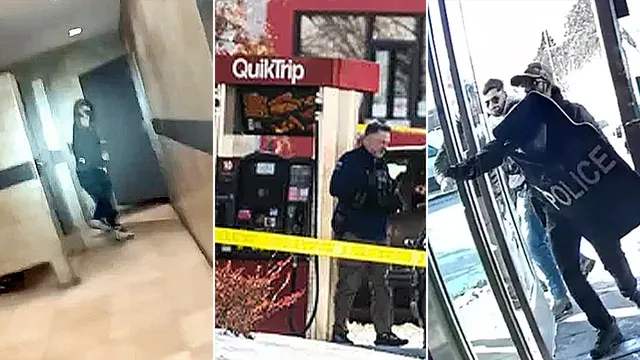
Illegal immigrant injures four officers in Omaha gas station shootout
- Juan Melgar-Ayala, an illegal immigrant from El Salvador, engaged in a shootout with police officers following the injury of a civilian.
- Four Omaha police officers sustained injuries in the gunfire exchange, but their injuries were not life-threatening.
- This incident underscores the importance of addressing issues related to illegal immigration and public safety.
Story
In the United States, a violent incident unfolded in Omaha, Nebraska, where a man named Juan Melgar-Ayala, an illegal immigrant from El Salvador, was involved in two separate shootings on December 3, 2023. The first shooting occurred at a grocery store, injuring a 61-year-old civilian named Michael Kasper, as he was loading his groceries into his vehicle. Shortly thereafter, the police managed to track Melgar-Ayala to a QuikTrip gas station, where he barricaded himself in the restroom. When the officers arrived, he confronted them and opened fire, leading to a serious shootout. During this confrontation with the Omaha police, Melgar-Ayala wounded four officers before being killed at the scene. The injured officers included Sgt. Emilio Luna and Detectives Brock Rengo, Jordan Brandt, and Christopher Brown. Thankfully, their injuries were reported as non-life-threatening. The incident has raised concerns over Melgar-Ayala's illegal status in the U.S. and his criminal history, which includes previous felony convictions for burglary. As investigations continued, officials highlighted that Melgar-Ayala had been on the run due to the earlier shooting of Kasper; the motivation for his violent actions remains unclear. Family members have mentioned that he suffered from mental health issues, capturing attention to the complex factors surrounding his criminal behavior. Each shooting left a trail of victims and raised questions about community safety and immigration policies. In light of these events, Nebraska's Governor, Pillen, criticized what he described as failures in border policy, linking the lax security measures to increased risks in communities. The Department of Homeland Security expressed condolences for the victims and praised the police for their response during the shooting. This harrowing series of events underlines the ongoing challenges faced by law enforcement and society regarding crime associated with illegal immigration and the mental health of offenders.
Context
Illegal immigration has been a subject of considerable debate across the United States, with various studies attempting to ascertain its impact on crime rates in different states. Nebraska, a state characterized by a diverse immigrant population, provides a unique backdrop for examining the connection between illegal immigration and crime. This report aims to synthesize available data and research findings pertinent to this topic, with an emphasis on understanding the dynamics at play rather than drawing sweeping conclusions. A considerable body of research suggests that the relationship between illegal immigration and crime is not straightforward. Many studies indicate that immigrants, including those who are undocumented, tend to commit fewer crimes than native-born citizens. For example, a study conducted by the Cato Institute found that both documented and undocumented immigrants are less likely to be incarcerated than native-born individuals. This suggests that the presence of illegal immigrants in Nebraska may not necessarily correlate with increased crime rates. However, it is essential to consider factors such as socio-economic conditions, local law enforcement practices, and community relations, which also influence crime trends. In Nebraska, the immigrant population has significantly contributed to the workforce and economy, particularly in sectors such as agriculture and services. The economic contributions of these individuals can foster better community relations and reduce crime by providing pathways to stability and integration. Local police departments often report that cooperation with immigrant communities can enhance public safety rather than compromise it. When undocumented immigrants fear deportation, they may be less likely to report crimes or cooperate with law enforcement, which can create an environment where crime goes unreported, further complicating the narrative around immigration and safety. Despite the various evidences suggesting that illegal immigration does not inherently increase crime rates, public perceptions can sometimes clash with statistical realities. High-profile crimes involving undocumented individuals can amplify fears and perpetuate stereotypes, influencing public policy and community sentiments. It is crucial for policymakers to rely on data-driven approaches rather than anecdotal evidence when addressing concerns related to crime and illegal immigration. By fostering community trust and understanding, Nebraska can continue to ensure safety and cohesion among all its residents, irrespective of their immigration status.
