

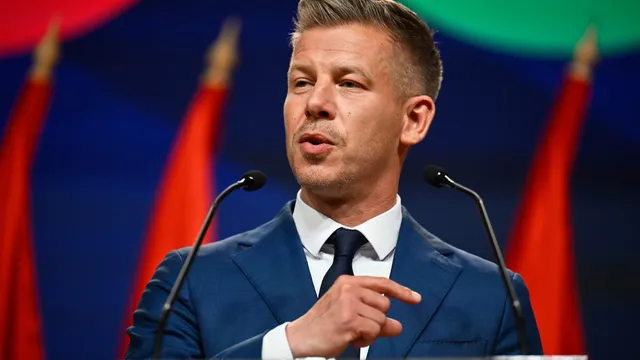
Péter Magyar takes office as Hungary shifts towards socialism
Péter Magyar takes office as Hungary shifts towards socialism
- Péter Magyar's Tisza party won a supermajority in Hungary's National Assembly, marking a significant electoral victory.
- He has announced cabinet appointments that indicate a shift toward socialism and a stronger alignment with the EU.
- Magyar's new government aims to restore democratic institutions and improve Hungary’s relationships with Western democracies.
Story
Hungary, on May 9, 2026, witnessed a significant political shift as Péter Magyar took his oath of office as the new prime minister, effectively ending Viktor Orbán's long-standing 16-year rule. Magyar, representing the center-right Tisza party, achieved a historic victory in the recent elections, securing a supermajority in the National Assembly, which allows for substantial changes to the constitution. This election was remarkable for its implications on Hungary's democratic framework, especially considering the political climate shaped by Orbán's nationalist and populist policies that had alienated the country from the European Union. Magyar's government is expected to adopt a more pro-EU and social-liberal stance, contrasting sharply with the previous administration's approach. As a part of his initial reforms, Magyar announced several cabinet appointments, including Anita Orbán as foreign minister and Andrías Kármán as finance minister, the latter known for advocating a socialist 'wealth tax' and pursuing the adoption of the euro as Hungary’s official currency. Furthermore, his administration plans to revive Hungary's relationship with the EU, addressing previous concerns regarding rule of law and corruption that had stalled the release of approximately 17 billion euros in EU funds needed to boost the stagnating economy. A notable policy shift includes the establishment of a new environment ministry and plans to display the EU flag in Parliament, symbolizing a break from the previous government's conservative trajectory and an openness to European values and collaborations. Overall, Magyar's leadership reflects a pivotal transition, prompting expectations of restoring democratic institutions and a return to governance focused on serving the populace rather than consolidating power.
Context
Hungary's political history under Viktor Orbán has been characterized by a significant shift towards nationalist policies and a consolidation of power that has reshaped the country's democratic institutions and civil society. Following his initial rise to prominence in 1998 when he became Prime Minister for the first time, Orbán's political narrative has consistently featured an appeal to national sovereignty, economic independence, and a rejection of foreign influence, particularly from the European Union (EU). His time in office has witnessed the rise of Fidesz, the ruling party, which has deployed a variety of strategies to maintain electoral dominance, including altering electoral laws and redefining the political landscape to sideline opposition parties. This has triggered concerns about the erosion of democratic norms and the rule of law within Hungary, as well as tensions with EU authorities over rule of law issues and media freedoms. One of the most significant developments during Orbán's tenure has been the implementation of a new constitution in 2011, which critics argue centralizes power within the executive branch, undermines judicial independence, and weakens checks and balances. This constitution has facilitated Orbán's ability to enact sweeping reforms that have reshaped various sectors, including education, healthcare, and the media. Critics have pointed to the establishment of a non-diverse media landscape that favors government narratives, alongside crackdowns on civil society organizations and dissenting voices. The rebranding of Hungary as an 'illiberal democracy' has been a point of significant contention in the discourse surrounding the relationship between governance and democratic principles within the EU. Throughout his tenure, Orbán has been a polarizing figure both domestically and internationally, utilizing rhetoric surrounding migration and national identity to bolster his support base. Against the backdrop of the EU's migration crisis in 2015, Orbán positioned himself as a staunch defender of Hungary's borders, constructing barriers and adopting policies to stem the influx of migrants. This nationalist stance has resonated with segments of the Hungarian population, consolidating his power but also intensifying divisions within society and drawing opposition from liberal factions both in Hungary and abroad. Orbán's foreign policy choices, often characterized by pragmatic relationships with autocratic leaders and a cautious approach towards Russia and China, have further complicated Hungary's position within the EU framework, raising questions about collective European values and solidarity. As of 2026, Viktor Orbán remains a dominant figure in Hungarian politics, having successfully maintained his role as Prime Minister through various electoral cycles. His governance has raised crucial debates about the balance between national sovereignty and adherence to European democratic standards, as well as the implications for the future of Hungary within the EU. The ongoing challenges regarding media freedom, judicial independence, and civil rights continue to define Hungary's political landscape under Orbán, posing difficult questions about the country's democratic trajectory. The narrative surrounding Hungary's political history under Orbán thus encapsulates a complex interplay of nationalism, governance, and the enduring struggle for the preservation of democratic values in a rapidly shifting political environment.


