

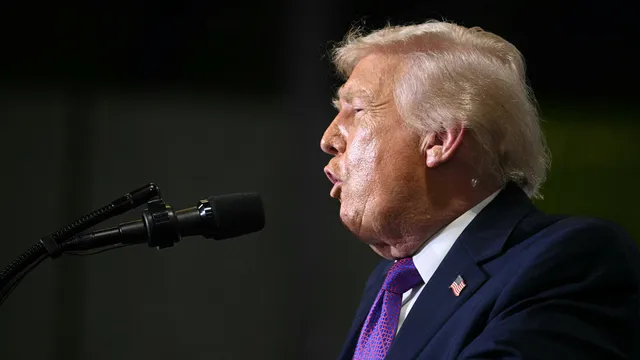
Trump delivers mixed messages on Iran at political rally
Trump delivers mixed messages on Iran at political rally
- President Donald Trump addressed his supporters about the ongoing conflict in Iran at a Kentucky rally.
- His comments highlighted a contradiction between claiming success in military actions and emphasizing the need to continue the mission.
- The rising gas prices and public concern about the war's economic effects could pose challenges for Trump's political support.
Story
In the United States, President Donald Trump spoke at a political rally in Hebron, Kentucky, addressing the ongoing war with Iran and the implications of rising gas prices. His remarks were notable for their ambivalence, asserting early victory but simultaneously suggesting that the U.S. mission was not yet complete. This uncertainty comes in the wake of American military actions in Iran, further complicated by a significant rise in gas prices, which have increased by 60 cents per gallon since the onset of conflict. Trump’s rally was intended to highlight his economic achievements as the November midterms approach, yet the growing discontent among his supporters regarding the war's effect on their daily lives, particularly in terms of rising fuel and food costs, posed a challenge. Many, including Trump supporters like truck driver Billie Jean Wright, expressed ambivalence about the Iran conflict, indicating that while they traditionally supported him, the current economic pressures have led them to reconsider their positions on the war. Moreover, Trump's attempt to support a primary challenger to Rep. Thomas Massie highlighted fractures within the MAGA coalition regarding foreign policy decisions and economic consequences. Polling indicates a divide among Americans over the strikes against Iran, complicating the political landscape for Trump as he navigates these issues. Amid these developments, Trump's remarks reflect a broader struggle to maintain unity within his base as economic challenges mount and tensions in international relations continue.
Context
The current state of the Iran conflict and U.S. foreign policy is framed by historical tensions, evolving international relations, and strategic considerations. Since the 1979 Iranian Revolution, the United States has viewed Iran as a significant threat due to its nuclear ambitions, regional influence, and support for militant groups. The U.S. has imposed numerous sanctions aimed at curtailing Iran’s nuclear program, which led to the Joint Comprehensive Plan of Action (JCPOA) in 2015. However, the U.S. withdrawal from the agreement in 2018 under the Trump administration has intensified hostilities and led to an escalation of military and diplomatic tensions between the two nations, complicated by Iran’s subsequent steps to advance its nuclear capabilities. In the context of U.S. foreign policy, there has been a shift between containment strategies and diplomatic negotiations. The Biden administration initially signaled a willingness to re-engage with Iran to revive the JCPOA, hoping to reduce nuclear proliferation and stabilize the region. However, ongoing discussions have faced hurdles due to Iran's demands, regional power dynamics, and geopolitical considerations involving allies and adversaries. This complex interplay of interests has led to a precarious situation where military confrontations could occur, particularly following incidents like the assassination of Iran's General Qassem Soleimani in 2020, which heightened anti-U.S. sentiment and facilitated a cycle of retaliation. Strategically, Iran has been active in extending its influence across the Middle East through proxies in countries such as Iraq, Syria, and Lebanon. This strategy poses challenges for U.S. interests and its allies in the region, such as Israel and Saudi Arabia. The conflicts in these regions, fueled by Iran's support for various groups, require the U.S. to balance military engagement with diplomatic efforts. The shifting alliances and the rise of adversarial coalitions in response to perceived U.S. hegemony further complicate effective policymaking, necessitating a nuanced approach that addresses both immediate threats and long-term regional stability. In conclusion, the Iran conflict encapsulates not only bilateral distrust between the U.S. and Iran but also wider geopolitical dynamics that influence global security. The U.S. foreign policy must navigate an intricate landscape of threats while considering domestic pressures, regional alignments, and international law. Achieving a sustainable peace will likely require a combination of diplomacy, strategic deterrence, and multilateral engagement that encompasses various stakeholders in the region. As events continue to unfold, the trajectory of U.S.-Iran relations remains critical, not just for the two nations but for wider stability in the Middle East.


