

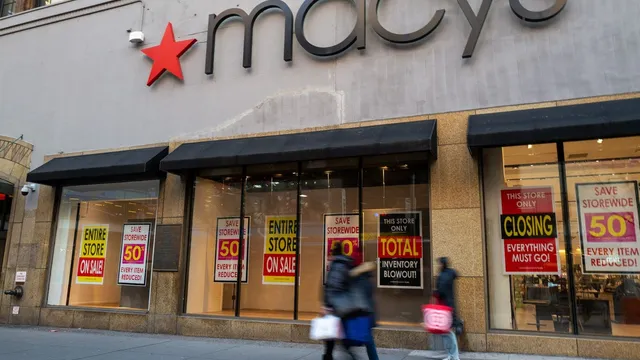
Macy's reports strong profits amid challenging retail environment
Macy's reports strong profits amid challenging retail environment
- Macy's reported net income of $507 million for the fourth quarter ending January 31, exceeding expectations.
- The company faces challenges from rising fuel costs and tariffs affecting retail pricing strategies.
- Despite strong quarterly results, Macy's maintains a conservative outlook due to ongoing market uncertainties.
Story
In February 2024, Macy's reported stronger-than-expected profits for the fourth quarter, which ended on January 31, illustrating a positive trend despite ongoing challenges in the retail sector. The retailer's net income reached $507 million, translating to $1.84 per share, while adjusted earnings per share stood at $1.67. This performance exceeded analysts' expectations, who predicted earnings of $1.57 per share on lower sales figures. During this period, comparable sales at established online and physical channels rose by 1.8%, alongside a 0.4% increase in overall comparable sales across the company. Despite this strong financial performance, Macy's faced significant challenges ahead. Rising geopolitical tensions, specifically an ongoing conflict in Iran, contributed to increased fuel prices, notably gasoline and diesel, which are critical for shipping products. Furthermore, the retailer dealt with the repercussions of tariffs and supply chain disruptions. As a result, even as Macy's implemented changes to improve merchandise offerings and customer service, the long-term outlook remained cautious. The company projected earnings per share between $1.90 to $2.10 for the following year, which was viewed as conservative compared to analysts' expectations of $2.20 on sales of roughly $20.97 billion. Macy's has also actively managed its store footprint, closing unprofitable locations while investing in modernizing others to better suit customer needs. Bloomingdale's, a subsidiary of Macy's, showed impressive growth with comparable sales increasing by 9.9%, which highlights the company's broader success in its luxury retail segment amidst various market challenges. However, the broader retail landscape remained volatile, with many retailers grappling with similar issues exacerbated by external factors and economic pressures. Looking forward, the company's outlook for net sales was projected between $21.4 billion and $21.65 billion for the upcoming fiscal year, with an expectation of comparable sales fluctuating between a decline of 0.5% and an increase of 0.5%. As industry experts point out, Macy's management expressed caution, citing uncertainties in the market, potential policy changes surrounding tariffs, and overall consumer spending patterns. Given that Macy's operates in a competitive and increasingly complex sector, the coming months would be crucial for delineating the company's path forward in adapting to these dynamic market conditions.
Context
The current state of the retail sector in the USA is undergoing significant transformation, shaped by evolving consumer behaviors, technological advancements, and economic factors. As of March 2026, the retail landscape is markedly different from previous years, driven largely by the lasting impacts of the COVID-19 pandemic, which accelerated trends towards e-commerce and digital shopping experiences. Retailers have had to adapt rapidly, adopting omnichannel strategies that integrate online and brick-and-mortar sales, enhancing customer engagement through personalization and convenience. Physical stores are evolving into experience centers, where consumers can interact with products in a meaningful way, supplementing their online shopping habits with experiences that cannot be replicated digitally. This shift highlights the importance of a hybrid retail strategy, balancing online presence with physical store offerings to meet diverse consumer preferences. In addition to changes in consumer behavior, the retail sector faces challenges tied to economic uncertainties, such as rising inflation and supply chain disruptions. Retailers have been cautious in their inventory management strategies, seeking to mitigate the impacts of these economic factors by optimizing their supply chains and focusing on demand forecasting. There is also a growing emphasis on sustainability in retail practices. Consumers are increasingly prioritizing environmentally friendly products and practices, prompting retailers to adopt sustainable sourcing and reduce waste throughout their operations. Brands that resonate with values of sustainability are likely to build stronger customer loyalty and enhance their market position. Emerging technologies play a crucial role in shaping the future of retail. Innovations such as artificial intelligence, augmented reality, and mobile payment solutions are transforming how retailers interact with consumers. AI-driven analytics enable retailers to gain insights into consumer preferences and behaviors, enabling personalized marketing strategies that drive conversion rates. Augmented reality tools are enhancing in-store experiences, allowing consumers to visualize products in their environments before making a purchase. Furthermore, the adoption of mobile payment technologies is facilitating seamless transactions, catering to the demands for convenience in shopping. Retailers that embrace these technologies are better positioned to thrive in a competitive landscape. Looking ahead, the retail sector in the USA will likely continue to evolve, with a focus on agility and responsiveness in addressing changing consumer needs. The integration of technology into the shopping experience will further evolve, and a stronger emphasis on sustainability will continue to influence purchasing decisions. Retailers must stay attuned to emerging trends and adapt their strategies accordingly to navigate the challenges and opportunities that lie ahead. Overall, the current state of the retail sector reflects a dynamic environment where adaptability and innovation are key drivers of success.


