

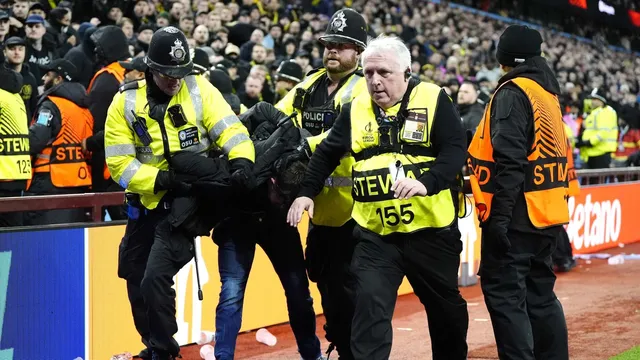
Violent clashes lead to arrests during Europa League match at Villa Park
Violent clashes lead to arrests during Europa League match at Villa Park
- Donyell Malen was injured by an object thrown by Young Boys fans during the match.
- Police arrested two fans for offences including affray as unrest escalated.
- The match ended in a 2-1 win for Aston Villa, overshadowed by the crowd violence.
Story
During a Europa League match on November 27, 2025, in England, Aston Villa faced off against Swiss club Young Boys at Villa Park. The atmosphere initially was vibrant, with Young Boys fans making significant noise, but the mood shifted dramatically once Aston Villa scored their first goal. Forward Donyell Malen was struck on the head by an object thrown from the away fans, leading to increased tensions between the supporters and the police present at the stadium. As further disturbances followed Villa's subsequent goal, police were forced to intervene, resulting in a temporary halt of the match. Disturbances included objects being thrown at players and police, which contributed to significant unrest among the away fans. Notably, at least two Young Boys fans were arrested on charges that included affray and assault against police officers. West Midlands Police stated that while the majority of the crowd behaved well, a small faction of away fans instigated violence, troubling the overall match experience and provoking a robust police response. Donyell Malen sustained an injury from the projectiles but continued playing, highlighting the rough nature of the interactions. The disorder escalated with items like seats and plastic bottles hurled towards players and officials. A spokesperson for West Midlands Police condemned such violence and announced an investigation into the incident, reviewing footage for further insights. Following the game, Young Boys manager Gerardo Seoane expressed regret over the incidents but noted that the reactions from supporters may have been provoked by Malen's celebrations after scoring. This unfortunate unrest mirrors prior incidents involving Young Boys fans in other matches and points to an ongoing issue regarding fan behavior during significant games. Incidents like these pose questions about safety and security at football matches, raising concerns about the measures needed to ensure such disturbances do not recur. The Europa League match concluded with Aston Villa securing a 2-1 victory, while Young Boys' only goal came in the dying moments of the match. However, the events overshadowed the accomplishment of both teams on the pitch and highlighted the need for strict measures to promote respectful behavior among football fans.
Context
The history of crowd trouble in football matches is a complex and multifaceted issue that has evolved over the years. It dates back to the early days of the sport, where passionate fans would often express their emotions in ways that could lead to unruly behavior. Incidents of violence, disorder, and rioting have been a part of the game since its inception, influenced by factors such as rivalries, alcohol consumption, and socio-economic conditions. The most notorious eras of fan violence occurred in the 1970s and 1980s, particularly in England, when hooliganism was rampant. This period saw numerous stadium disasters and confrontations, prompting authorities and clubs to take a hard stance on crowd control and fan behavior. In response to the escalating violence, various measures were implemented to improve safety in stadiums, including designated seating, stricter entry requirements, and a greater police presence. Notably, the establishment of the Taylor Report in 1990 led to significant reforms in English football. The report advocated for all-seater stadiums, better facilities, and improved crowd management practices, which dramatically reduced incidents of crowd trouble and increased the overall experience for fans. Despite the progress made in the subsequent decades, challenges remain in addressing issues of crowd trouble. Incidents still occur, often fueled by intense rivalries and the presence of troublemakers who seek to disrupt the match experience. Modern technology, such as CCTV and facial recognition, has been employed to identify and apprehend offenders, while clubs have also instituted bans for those caught engaging in violent or disorderly behavior. Furthermore, social media has become both a tool for organizing fan events and a platform for inciting violence, adding an additional layer of complexity to the issue. In recent years, football governing bodies have recognized the need for a comprehensive approach that not only addresses fan behavior but also promotes positive engagement and inclusivity. Campaigns to reduce violence, promote sportsmanship, and encourage family-friendly atmospheres have gained traction. Initiatives focused on fan education, community engagement, and collaboration between law enforcement and clubs have also become integral to developing a safer environment for all spectators. While significant strides have been made in curbing crowd trouble in football matches, ongoing vigilance and innovative strategies remain key to ensuring the sport continues to be a source of enjoyment and pride for fans worldwide.


