

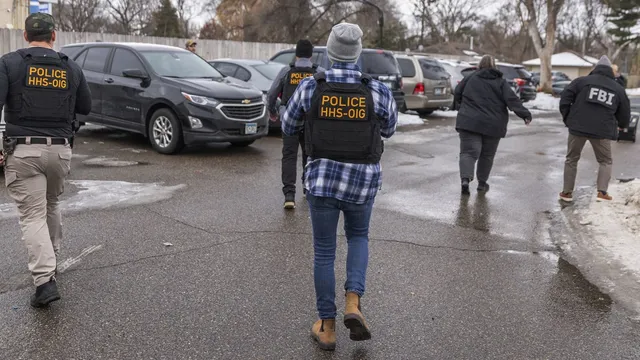
Federal judge halts DHS termination of family reunification programs
Federal judge halts DHS termination of family reunification programs
- A federal judge temporarily blocked DHS from ending certain Family Reunification Parole programs.
- The decision affects migrants from seven countries awaiting legal status in the U.S.
- The ruling indicates a need for proper notification before terminating such programs.
Story
In the United States, a Massachusetts federal judge issued a temporary block on the Department of Homeland Security's (DHS) plan to terminate Family Reunification Parole (FRP) programs for certain migrants. Judge Indira Talwani ruled that DHS likely failed to provide the necessary notice to individuals affected by this decision. The FRP programs allow relatives of U.S. citizens or lawful permanent residents from seven countries, including Haiti and Honduras, to enter the U.S. temporarily while awaiting immigrant visas. The termination notice, set for January 14, 2026, has caused widespread concern among affected families. DHS declared in December that it would terminate FRP programs as part of moves to end what it described as the abuse of humanitarian parole. The agency argued that the previous regulations allowed individuals to bypass typical vetting procedures, which conflicted with their approach to immigration enforcement. The move has drawn criticism, particularly regarding the lack of communication to current parole recipients. The judge's order also emphasized the importance of providing proper individualized notice before ending someone's legal status. As the situation unfolds, DHS has been required to provide documentation on its decision-making processes concerning the FRP termination by January 13, 2026. This ruling is seen as a critical victory for advocates of immigrant rights, as many families have been anxiously awaiting clarity on their legal status. Affected individuals were left in uncertainty about their rights and potential impacts on family reunifications as the government pushed to bring an end to these programs. This development highlights the ongoing national debate over immigration policy under the current administration, as many express concerns about the implications of such decisions on immigrant families. Advocacy groups are preparing to respond, emphasizing the necessity of maintaining these important pathways for familial unity amidst changing policies and enforcement practices around immigration.
Context
The Family Reunification Parole program is designed to facilitate the reunification of designated family members with individuals who hold lawful permanent resident or U.S. citizen status. This program underscores the importance of family unity and aims to provide an expedited pathway for eligible applicants, emphasizing the U.S. government's commitment to ensuring that families are not unnecessarily separated due to immigration policies. Under this program, eligible individuals may receive temporary parole to enter the United States while their immigration statuses are being processed, allowing them to be with their families during this waiting period. The requirements for participation in the Family Reunification Parole program are clearly outlined. Applicants must be immediate relatives of U.S. citizens or lawful permanent residents. This typically includes spouses, children, and, in some cases, parents of the U.S. citizen or permanent resident. Furthermore, applicants must undergo background checks and demonstrate that they pose no threat to public safety, ensuring that the integrity of national security and public welfare is maintained. Once the eligibility criteria are satisfied, the application process begins, which does require thorough documentation, including proof of family relationship and a commitment to follow any additional requirements set forth by immigration authorities. Processing times for applications can vary based on individual circumstances and the current workload of immigration agencies. However, proponents of the program advocate that it provides essential benefits by allowing overseas family members to reunite with loved ones in the U.S. more quickly than traditional immigration paths might allow. The temporary parole granted is not a pathway to permanent residency but serves as a crucial bridge for families during their immigration journey. It is an acknowledgment of the emotional and practical challenges faced by families separated by international borders and an effort to streamline the process of family reunification. Overall, the Family Reunification Parole program plays a significant role in promoting familial stability within the U.S. While the program does not solve all immigration-related issues, it highlights a focused initiative aimed at reuniting families while reinforcing the principles of family unity. As policies evolve, continued advocacy for further improvements to the program and its processes remains important to ensure that it serves the needs of families and reflects the United States' values of compassion and support for those seeking a better life.


