

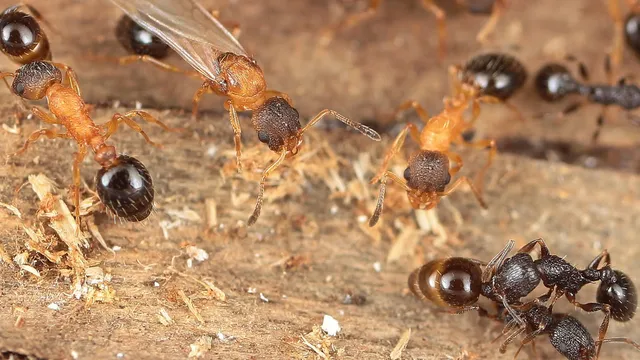
Unique ant species reproduces exclusively by cloning in Japan
Unique ant species reproduces exclusively by cloning in Japan
- Temnothorax kinomurai was confirmed to consist solely of queens, lacking both workers and males.
- The species reproduces asexually via parthenogenesis, producing offspring without male fertilization.
- This discovery highlights unique evolutionary adaptations in ant social structures and reproductive strategies.
Story
In Japan, a recent study has made a groundbreaking discovery about a rare ant species known as Temnothorax kinomurai. Traditionally, ant colonies have a clear structure consisting of queens, non-reproductive female workers, and males; however, this specific species defies that stereotype as it is composed entirely of queens, with no male ants or workers within its colonies. The research provided the first-ever evidence confirming that T. kinomurai reproduces exclusively through asexual means, specifically parthenogenesis, meaning that the offspring are essentially clones of the queens themselves. This finding challenges what was believed for nearly four decades about the species, which had previously been suspected to consist solely of queens due to unusual behaviors observed. Researchers collected six colonies of T. kinomurai and observed them in lab conditions, where they successfully bred and raised 43 queen offspring without any fertilization occurring. The study revealed that the eggs produced by these queens developed into new queens independently and without the aid of males, marking a significant deviation from the reproductive habits commonly seen in ant species. In the course of studying this unique ant, researchers noted abnormal behaviors, as T. kinomurai had been documented for its parasitic antics, manipulating the workers of closely related ant species to eliminate their host queen. The study further involved meticulous inspections, revealing that the anatomy supporting male fertilization in the queens was, in fact, non-functional. This revelation has prompted scientists to explore the evolutionary implications of such a reproductive strategy and the peculiar traits of T. kinomurai. In moving forward, researchers plan to investigate the environmental and evolutionary conditions that may have led to the loss of males and workers in the species, enhancing our understanding of ant behaviors and colony dynamics in parasitic relationships.


