

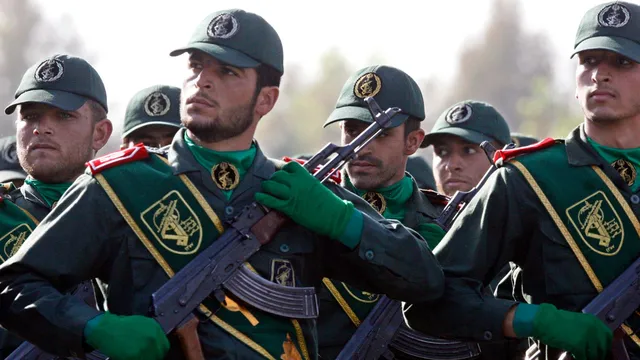
EU designates Iran's Revolutionary Guard as terrorist organization amid protests
EU designates Iran's Revolutionary Guard as terrorist organization amid protests
- In January 2026, Iran experienced a significant crackdown on widespread protests leading to thousands of deaths.
- The European Union imposed sanctions on Iranian officials, including a resolution to categorize the Islamic Revolutionary Guard Corps as a terrorist organization.
- This decision reflects a significant shift in Europe's diplomatic approach to Iran amidst growing international concerns over human rights abuses.
Story
Iran is grappling with a severe internal crisis characterized by widespread protests against its government. In January 2026, a violent crackdown on these protests resulted in thousands of deaths, prompting severe international condemnations. This crackdown was a response to escalating public dissent against the regime's authoritarian practices. The protests, sparked initially by economic grievances, soon morphed into a wider challenge to the Islamic Republic's authority, reflecting the deep dissatisfaction among Iranian citizens. In light of these events, the European Union adopted new sanctions against Iranian officials, including a notable resolution to label the Islamic Revolutionary Guard Corps as a terrorist organization. This decision marks a significant shift in Europe’s approach to Iranian leadership and serves as a response to the alleged violence used against peaceful protestors. European diplomats highlighted the need for accountability for the brutality exhibited by Iranian authorities toward their citizens, declaring that such actions cannot be tolerated on the international stage. While these sanctions are largely symbolic, they add another layer of pressure on an already strained Iranian economy. The Iranian government, in response, summoned European ambassadors to express its outrage over the EU's stance, proclaiming that it would consider all EU militaries as terrorist groups according to a 2019 law. Meanwhile, military tensions in the region are mounting, with the U.S. deploying naval resources in proximity to Iran, amid fears of a larger conflict. These developments signify an increasingly complex geopolitical landscape where international diplomatic relations and domestic unrest intersect dramatically, raising questions about the future stability in Iran and its potential impact on regional security.
Context
Iran's relationship with Russia and the West has been shaped by a complex interplay of historical, geopolitical, and ideological factors. Since the Islamic Revolution in 1979, Iran has sought to establish itself as a regional power, often positioning itself in opposition to Western influence, particularly that of the United States. This adversarial stance has led Iran to cultivate stronger ties with Russia, a nation that shares similar interests in countering Western hegemony. Both countries have collaborated on various fronts, including military cooperation, energy projects, and diplomatic efforts, most notably in the context of the Syrian Civil War where both have supported the regime of Bashar al-Assad. This partnership has allowed Iran to gain crucial military support and diplomatic cover while providing Russia with a foothold in the Middle East, thereby enhancing its influence in the region. However, the relationship between Iran and Russia is not without its limitations and complexities. Historical grievances and competition for influence in Central Asia and the Caucasus illustrate the tenuous nature of their alliance. Despite their current cooperation, both nations remain wary of each other's long-term ambitions and often prioritize their own national interests over a unified front. This dynamic can lead to friction, particularly as both countries navigate their relationships with other regional powers and the West. Russia's approach towards Iran reflects a balancing act of maintaining a strategic partnership while limiting Iran's regional aspirations that may conflict with Russian interests. In contrast, Iran's relationship with the West, particularly the United States, has remained fraught with tension and suspicion. The imposition of economic sanctions, stemming from concerns over Iran's nuclear program, has further strained these ties. The Joint Comprehensive Plan of Action (JCPOA), established in 2015, appeared to offer a pathway towards improved relations; however, the U.S. withdrawal from the agreement in 2018 under President Trump effectively dismantled the diplomatic progress made. This action not only galvanized Iran's antagonism towards the West but also solidified its ties with Russia, as both nations sought to insulate themselves against what they perceive as Western aggression. The current geopolitical landscape sees Iran leveraging its relationship with Russia to mitigate the effects of Western sanctions and to assert its influence in the Middle East. The future of Iran's relationships with both Russia and the West will largely be shaped by shifting global dynamics, including rising powers, regional conflicts, and the evolving nature of international diplomacy. For Iran, aligning closely with Russia provides a strategic counterbalance to U.S. influence; however, the mutual benefits must be weighed against the inherent risks of dependence on an often-unreliable ally. Conversely, the West's approach to engaging with Iran may shift depending on broader geopolitical considerations and the potential for regional stability. As both Iran and Russia navigate their complex historical ties and current interests, their relationship will likely continue to proof a crucial factor in shaping the geopolitical landscape of the Middle East and beyond.


