
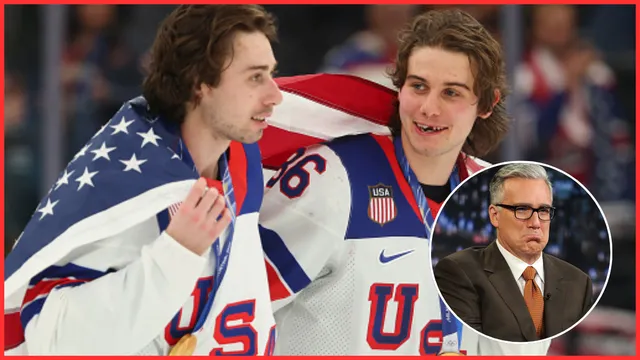
Keith Olbermann attacks USA men's hockey team for accepting Trump's invite
- The U.S. men's hockey team won the Olympic gold medal at the 2026 Winter Olympics, celebrated as a major achievement.
- President Donald Trump invited both the men’s and women’s teams to the State of the Union address.
- Keith Olbermann faced backlash for criticizing the men’s team for wanting to accept the invitation, stating it was a 'misogynistic' move.
Story
In the aftermath of the U.S. men's hockey team winning the gold medal at the 2026 Winter Olympics, they were invited by President Donald Trump to attend the State of the Union address. This victory, which took place on February 22, 2026, marked a significant achievement for American sports as it was the first gold in men's hockey since the legendary 'Miracle on Ice' in 1980. The team celebrated their victory across various venues in Miami upon returning from Italy, showcasing their pride in representing the U.S. and their success on the ice. However, this celebratory spirit was met with criticism from notable commentator Keith Olbermann, who labeled the men’s team as "misogynistic" for considering the president's invitation, contrasting their decision with that of the women's hockey team, who declined the invitation due to prior commitments. Olbermann's remarks highlighted a deeper societal divide impacting sports, where individuals perceived political affiliations can overshadow achievements. Former NHL star Jeremy Roenick, among others, defended the men's team, emphasizing that sports should unify the country rather than be politicized. Roenick expressed disappointment at the backlash faced by the players, asserting that the focus should be on celebrating their Olympic achievement rather than engaging in political discourse. The conflicting reactions to the men's team accepting the invite reflect the complexities of national pride and political engagement in contemporary sports culture, stirring debate among fans and commentators alike. Ultimately, the men's hockey team's gold medal victory should be celebrated as a moment of unity and national pride, despite the criticisms aimed at those who choose to accept recognition from their country's leaders. The ongoing discourse surrounding the intersection of sports and politics remains a polarizing topic in America.
Context
Keith Olbermann, a well-known sports commentator and journalist, has not shied away from voicing his opinions on various issues in sports, including the performance of national teams. In his criticism of the U.S. men's hockey team, Olbermann has expressed disappointment over the team’s lack of competitive edge and consistent underperformance in international tournaments. His commentary often emphasizes the importance of not only skill and talent but also the mentality and commitment required to succeed on an international stage. He believes that the U.S. men's hockey team has underachieved, especially in contrast to other teams like Canada or Sweden, which have maintained a strong presence in international hockey competition. One of Olbermann's key arguments revolves around the failure of the U.S. system to nurture and develop top hockey talent. He has pointed out that while the U.S. has produced elite players, there appears to be a disconnect in translating that talent into team success. This criticism extends to the training regimens, selection processes, and strategic choices made by coaches and management. He advocates for a more integrated approach to player development that emphasizes teamwork and international experience, which are crucial for competing against hockey powerhouses. Furthermore, Olbermann's comments often underline the broader cultural attitudes towards hockey in the U.S. While the sport has a passionate fan base and a growing number of participants, it still competes for attention against more mainstream sports like basketball, football, and baseball. He believes that there needs to be a significant shift in how hockey is perceived and supported at all levels, from youth leagues to the professional ranks. Increased investment in grassroots programs could foster a new generation of players who are better prepared for international competition. In conclusion, Olbermann’s criticism of the U.S. men's hockey team highlights key areas for reflection and improvement. He advocates for a critical reassessment of player development, coaching strategies, and cultural attitudes towards hockey. By emphasizing the need for a more robust system that prioritizes combined skills and mental toughness, he calls for a renewed commitment to excellence in U.S. hockey. The discourse generated by his views invites stakeholders within the sport to address these challenges head-on and strive for a stronger presence on the international stage.
