

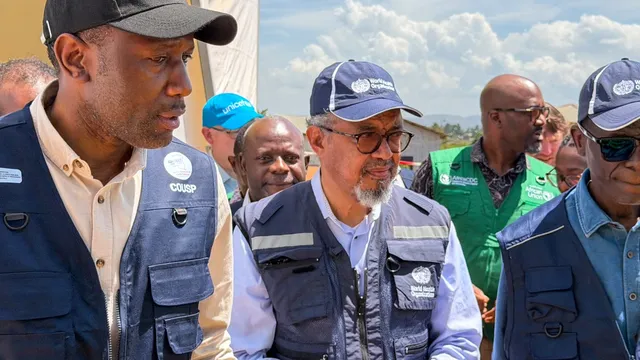
WHO chief visits DR Congo as Ebola outbreak escalates
WHO chief visits DR Congo as Ebola outbreak escalates
- The Democratic Republic of Congo is experiencing a severe outbreak of the Bundibugyo strain of Ebola, with over 1,100 suspected cases reported.
- Tedros Adhanom Ghebreyesus visited the epicenter in Bunia to assess the situation and meet with local health officials.
- Despite the WHO's confidence in DR Congo's ability to manage the outbreak, independent observers express concern over the rapid spread and inadequate response.
Story
In late May 2026, the Democratic Republic of Congo (DR Congo) faced a severe outbreak of the Bundibugyo strain of Ebola, which has resulted in over 1,100 suspected cases and at least 246 deaths. The outbreak began in Ituri Province, with the World Health Organization (WHO) reporting that the rapid spread of the virus has outpaced the response efforts. Tedros Adhanom Ghebreyesus, the Director-General of the WHO, visited Bunia, the epicenter of the outbreak, to assess the situation and meet with local health officials and affected families. He expressed confidence in DR Congo's ability to manage the outbreak, citing the country's previous experiences with Ebola. However, independent observers and organizations like Médecins Sans Frontières (MSF) have raised concerns about the alarming speed of the outbreak and the inadequacy of the current response. They emphasized the need for increased testing, medical personnel, and community engagement to effectively combat the disease. The outbreak has also been complicated by ongoing conflicts in the region, which hinder access to affected areas and contribute to local resistance against health protocols. As the situation evolves, the WHO continues to monitor the outbreak and provide support to local health authorities.
Context
The World Health Organization (WHO) plays a critical role in responding to epidemics and pandemics, functioning as the directing and coordinating authority on international health. Established in 1948, the WHO's mission includes ensuring that the way countries respond to health crises is scientifically backed, equitable, and effective. Central to its operations is the Global Outbreak Alert and Response Network (GOARN), which enables WHO to mobilize partners and resources swiftly for outbreak response. During health emergencies, the organization provides vital technical assistance, disease surveillance, and guidance to member states, thus facilitating an organized and effective global response to health threats. One of the primary responsibilities of the WHO is to establish and disseminate international health regulations, which set out the obligations of countries to report outbreaks and take necessary health measures. These regulations help in creating a standardized approach to managing health crises, allowing for timely notifications and collaboration. The WHO also engages in risk assessment and the classification of disease threats, enabling governments and health authorities to allocate resources efficiently. By coordinating laboratory networks and providing guidelines for diagnosis and treatment, WHO builds global capacity to confront epidemics, thereby reducing the impact on health systems and communities. In recent years, the WHO's response to epidemics such as the Ebola outbreak in West Africa and the COVID-19 pandemic has highlighted both the effectiveness and challenges of its role. For instance, in the case of Ebola, WHO's rapid deployment of emergency response teams, development of treatment protocols, and collaboration with local health authorities were pivotal in controlling the outbreak. However, criticisms emerged regarding the initial response timelines and the need for greater transparency and accountability, leading to calls for reforms in how the organization functions during crises. Furthermore, the COVID-19 pandemic underscored the necessity for global cooperation and information sharing, as countries faced unprecedented health challenges that required a unified approach. Overall, the WHO's impact on epidemic responses is profound, yet it continually faces pressures to adapt to evolving health threats and shifting geopolitical landscapes. As global health challenges become more complex due to factors such as climate change, urbanization, and global travel, the WHO's role will remain crucial in promoting health security and equity worldwide. Strengthening its capabilities, fostering transparency, and enhancing collaboration between countries will be essential for the WHO to effectively manage future health crises and safeguard global health.


