

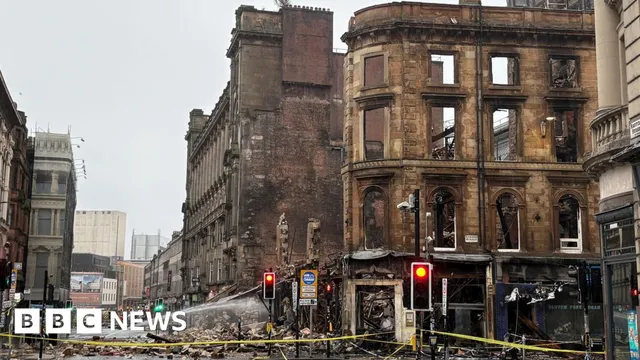
Eyewitness confronts vape shop fire that engulfs Glasgow building
Eyewitness confronts vape shop fire that engulfs Glasgow building
- A fire broke out in a vape shop on Union Street around 15:45 on Sunday, leading to explosions and rapid spread.
- Efforts to combat the fire were hindered by the explosions, which prompted emergency services to act quickly.
- The building partially collapsed and significant transport disruptions were reported in the surrounding area.
Story
On a Sunday afternoon, a significant fire broke out in a vape shop located on Union Street in Glasgow, Scotland, around 15:45. An eyewitness, Lamin Kongira, reported that he observed a small fire under the counter of the shop, which was triggered by an adapter charging system filled with chargers. Despite his attempt to use a fire extinguisher, two explosions occurred, prompting him to retreat for safety and warn others nearby. The blaze escalated quickly, engulfing the entire four-floor building, known as Union Corner, and leading to its partial collapse hours later. The rapid spread of the fire posed serious risks, and emergency crews were dispatched immediately to address the situation. Approximately six firefighting teams responded to the incident, and although the fire was reported to be under control, smoke was seen billowing out of the shop into the street. The fire not only destroyed the building but also caused significant disruptions in the surrounding area, notably affecting transport services to and from Glasgow Central Station, which lay adjacent to the site of the fire. In the aftermath, transport authorities warned of potential delays and closures for several days as safety inspections were underway. Meanwhile, local officials expressed concerns about the future of the building, which dates back to the 19th century, highlighting the cultural and historical significance of the area surrounding the station and the building, which pre-dated it. Emergency services confirmed no injuries reported amidst the chaos, which was viewed as a fortunate outcome given the severity of the incident. Officials also indicated that the Scottish government would assist Glasgow City Council to facilitate recovery efforts for the city center. Community responses highlighted emotional sentiments stemming from the destruction of a beloved local landmark, with residents noting the beauty of the area and their hopes for recovery. Investigations are now underway to determine the cause of the fire, with calls for thorough inquiries to prevent such incidents in the future.
Context
The fire at Glasgow Central Station, which occurred in recent months, had significant repercussions on transport in the city and surrounding areas. This incident resulted in temporary closures and service interruptions that affected numerous train services, exposing the vulnerability of key transport infrastructures. Passengers faced considerable inconvenience as travel routes were altered and many were left scrambling for alternative means of transit. The implications extended beyond immediate disruptions, as the incident raised concerns about safety protocols and the adequacy of response measures in place for public transport systems. Engineers and safety officials launched an investigation to understand the cause of the fire and implement solutions to prevent similar incidents from occurring in the future. In the aftermath of the fire, emergency services were promptly deployed to manage the situation, showcasing the efficient response capabilities of local authorities. However, the cascading effects of the fire extended to neighboring transport systems, with bus services experiencing an increased demand due to the suspension of train services. The local government had to quickly allocate resources and coordinate with different transport providers to adapt to the sudden changes. The acute response and the community’s resilience were commended as they worked collaboratively to ensure that people could still access essential services and workplaces despite the disruptions. As recovery efforts commenced, Glasgow Central Station underwent extensive assessments to determine the extent of the damage and the time frame required for repairs. Stakeholders in the transport sector saw this as an opportune moment to review existing safety standards and upgrade infrastructure to become more resilient against potential hazards. There was also a renewed focus on communication strategies to keep the public informed about ongoing changes and expected timelines, enhancing the overall transport experience for users. With transport being a critical component of urban life, the incident served as a wake-up call that emphasized the need for constant evaluation and preparedness. Looking forward, plans are being developed for both immediate repairs and long-term enhancements to transport networks in Glasgow. The collaboration between local government, transport agencies, and community organizations will be crucial in forging a more robust transport system. Future developments will aim not only at restoring normalcy but also at ensuring greater resilience against unforeseen challenges. This fire incident has catalyzed discussions on investment in safety technologies and the importance of sustainable transport practices that can withstand various emergencies, ultimately leading to a safer, more efficient transportation framework for Glasgow.


