

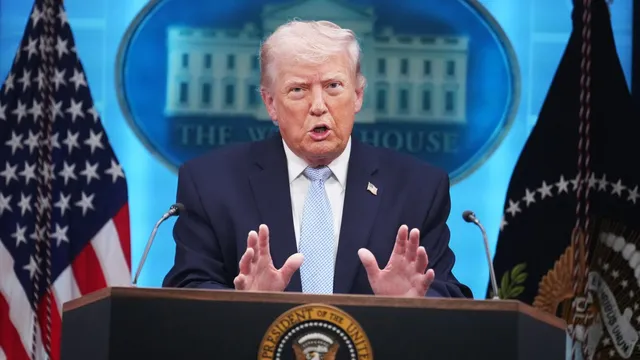
Conservatives push for removal of Trump amid Iran conflict
Conservatives push for removal of Trump amid Iran conflict
- Donald Trump's warning about Iran has prompted many conservatives to call for his removal from office.
- Notable figures such as Marjorie Taylor Greene and Tucker Carlson have openly criticized Trump's escalating rhetoric.
- This internal party dissent may lead to significant political consequences as calls for accountability grow.
Story
In the United States, recent rhetoric from President Donald Trump regarding Iran has sparked considerable dissent even among conservatives. Following a warning from Trump that suggested catastrophic consequences for Iran, there has been a growing yet alarming call for invoking the 25th Amendment, which would allow for his removal from office. Influential figures such as Republican Marjorie Taylor Greene and others have openly stated that Trump’s statements demonstrate an inability to perform his presidential duties. Greene characterized his rhetoric as 'evil and madness' through social media, signaling an unprecedented push for accountability within the Republican party. Moreover, the situation is exacerbated by Trump's escalating military posture towards Iran. Conservative pundits, including Tucker Carlson, have urged U.S. officials to dissuade Trump from potential mass attacks and even hinted at the consideration of nuclear options, a move Carlson has condemned. This internal discord among conservatives has never been more pronounced, with public statements and social media posts radiating dissent aimed at Trump's approach to foreign policy. As conversations heat up, figures like Scott McConnell have also queried why Cabinet members have yet to act on invoking the 25th Amendment. This dissatisfaction is echoed in a few Republican lawmakers who have voiced their reservations on military actions, expressing a need for more control over use of force and a desire for congressional approval before further escalation. Highlighting a schism within the party, the situation now faces an uncertain outcome as Democratic lawmakers amplify their calls for Trump's removal, contrasting the typically unified Republican stance. Controversies surrounding Trump's presidency seem to be reaching new heights as tensions rise internationally. The potential financial implications are daunting, as Congress wrestles with funding requests for military operations that could amount to $200 billion. As Trump’s rhetoric towards Iran triggers fears of a much larger conflict, the political landscape remains volatile, leaving his future as president increasingly precarious. Republican leaders now face the daunting task of navigating these challenges while grappling with internal party divisions, an electorate that appears to be increasingly skeptical, and a pressing need for cohesive leadership moving forward.
Context
The 25th Amendment to the United States Constitution, ratified in 1967, addresses presidential succession and disability. It provides a clear procedure to follow in the event that a president is unable to perform their duties due to health issues, personal incapacity, or any unforeseen circumstances. The 25th Amendment comprises four sections, with the first two being particularly instrumental in situations of presidential incapacity, either temporary or permanent. The invocation of these provisions has historically been a point of significant discussion and analysis in American political discourse, particularly when considering the health and cognitive ability of sitting presidents. Historically, the invocation of the 25th Amendment has been rare. Instances include President Dwight D. Eisenhower, who temporarily transferred power to Vice President Nixon during medical procedures in 1956 and again in 1957. Another notable instance was in 1985 when President Ronald Reagan underwent surgery for a gunshot wound sustained during an assassination attempt; he invoked the 25th Amendment to transfer power temporarily to Vice President George H.W. Bush. These events raised public awareness about the procedures that are in place, reflecting the importance of a clear delineation of authority in times of presidential incapacity. In more recent years, discussions surrounding the 25th Amendment have resurfaced, especially regarding the mental and physical fitness of presidents. The conversations began to gain traction around the presidencies of George W. Bush, Barack Obama, Donald Trump, and Joe Biden. The amendment's provisions have been analyzed in the context of health crises, cognitive assessments, and the responsibilities held by vice presidents during periods of uncertainty. Critics and advocates have debated how effectively the 25th Amendment can be invoked without causing political upheaval or undermining the stability of executive power. As of April 2026, there have been calls to revisit and potentially refine the 25th Amendment's procedures to ensure a robust response to future instances of presidential incapacity. Scholars and lawmakers have examined how to streamline the invocation process while preserving the necessary checks and balances among the legislative and executive branches. Given the unpredictable nature of executive health and unforeseen crises, this discussion remains critical in ensuring American democracy's resilience and preparedness in the face of challenges concerning presidential leadership.


