

US deploys military assets amid rising tensions with Iran
US deploys military assets amid rising tensions with Iran
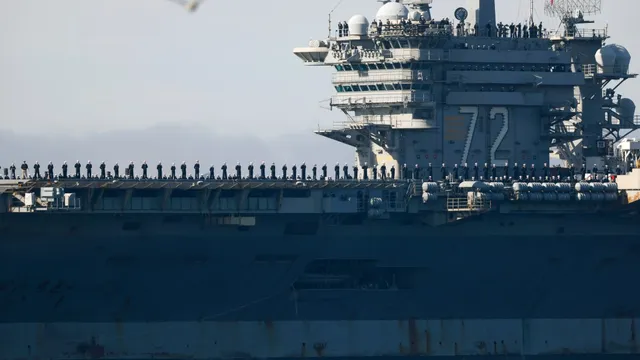
- At least one U.S. aircraft carrier is being sent to the Middle East to increase military readiness.
- The U.S. currently has about 30,000 troops in the Central Command area, with no active aircraft carriers deployed.
- The deployment aims to enhance U.S. options for responding to potential Iranian aggression amid ongoing domestic unrest in Iran.
Story
In response to escalating tensions with Iran, the United States has begun moving military assets to the Middle East. Notably, at least one aircraft carrier is making its way to the region as military planners prepare a range of options for potential strikes against Iranian targets. Currently, there are about 30,000 U.S. troops stationed in the U.S. Central Command area, but no aircraft carriers are actively deployed there. The deployment aims to enhance military readiness and provide options for the U.S. government, which is contemplating its next steps amid growing threats from Iran and domestic unrest within the country. Furthermore, military officials have indicated that the ongoing unrest in Iran, which includes nationwide protests and crackdowns, has contributed to the heightened tension between the two nations. The U.S. presence in the region, bolstered by destroyers and Littoral Combat Ships, would be reinforced with additional missile defense systems to secure U.S. bases and Israel. Experts have expressed concerns about the U.S.'s current weapons stockpile, noting that while it remains powerful, some parts have been depleted due to past conflicts and aid to allies like Ukraine and Israel. The stockpile situation highlights the complexities of U.S. military readiness and its implications for potential future engagements. Military analysts suggest that while the U.S. still possesses a robust arsenal, concerns exist surrounding specific munitions, especially in light of ongoing global conflicts. The U.S. military's capability to respond to threats has come into sharper focus, particularly as tensions with Iran increase. Recent military strategies stress the importance of maintaining deterrence without overextending existing resources. As the situation continues to evolve, the potential for direct military action remains a serious consideration for the U.S. government. Analysts warn that a conflict with Iran could lead to significant consequences, including retaliatory strikes against U.S. forces or allies in the region. With Iranian military capabilities and regional responses taken into account, U.S. military planners face the challenge of crafting strategies that balance offensive operations with the need for a swift and effective military response if required. The unfolding events may significantly influence U.S.-Iran relations and broader dynamics in the Middle East.
Context
U.S.-Iran relations have been shaped by a complex historical context that spans over a century. Initially, the relationship was primarily based on strategic interests and economic partnerships, especially concerning Iran's oil reserves, which attracted American interest in the early 20th century. The 1953 coup, orchestrated by the CIA to overthrow democratically-elected Prime Minister Mohammad Mossadegh, marked a significant turning point, embedding mistrust within the Iranian psyche towards the United States. The coup aimed to reinforce Western control over Iranian oil and re-establish the power of the Shah, leading to a dictatorship that suppressed political dissent and fueled resentment among various factions in Iran, which later contributed to the Islamic Revolution in 1979. The aftermath of the 1979 Islamic Revolution resulted in a drastic shift in U.S.-Iran relations, as the newly established Islamic Republic viewed the United States as the "Great Satan," responsible for decades of oppression and imperialism. The subsequent hostage crisis, where 52 American diplomats and citizens were held captive for 444 days, further deteriorated relations, leading to a complete rupture of diplomatic ties. Economic sanctions were imposed, marking the beginning of a long period of hostility, marked by military confrontations and severe political rhetoric. This animosity extended into the subsequent decades, shaping U.S. foreign policy in the Middle East and creating a narrative of Iran as a state sponsor of terrorism, particularly after its involvement in conflicts within the region. In the 21st century, U.S.-Iran relations experienced brief moments of engagement but remained predominantly adversarial. The 2003 invasion of Iraq, which the U.S. justified based on the existence of weapons of mass destruction, further complicated the relationship as Iran capitalized on the power vacuum created by the ousting of Saddam Hussein. The nuclear program developed by Iran became a pivotal issue, leading to a series of negotiations that culminated in the Joint Comprehensive Plan of Action (JCPOA) in 2015. The agreement aimed to curb Iran’s nuclear ambitions in exchange for sanctions relief but was fiercely debated within U.S. politics and faced criticism from various quarters, including Israel and Gulf Arab states. The U.S. withdrawal from the JCPOA in 2018 under the Trump administration marked another significant setback in relations, triggering a renewed cycle of sanctions and military tensions, including a series of attacks and retaliatory measures in the region. The Biden administration's approach has aimed at restoring diplomatic engagement while addressing regional security concerns, reflecting a desire to navigate the complexities of U.S.-Iran relations by balancing national interests and international agreements. However, as of January 2026, the path to constructive dialogue remains fraught with challenges, influenced by domestic politics in both nations, ongoing geopolitical rivalries, and the broader context of Middle Eastern stability.


