

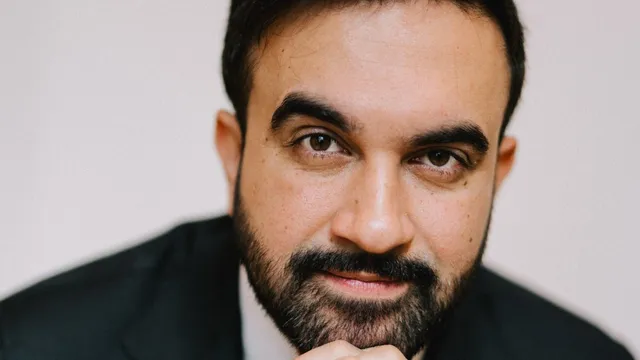
Zohran Mamdani becomes New York City's first Muslim mayor
Zohran Mamdani becomes New York City's first Muslim mayor
- In November 2025, Zohran Mamdani was elected as New York City's first Muslim mayor, signifying a historic moment for the city's Muslim community.
- His campaign emphasized policy reforms focused on working-class New Yorkers, including universal childcare and free public transit.
- Mamdani's victory has fostered unity among various Muslim sects and signals a shift within the Democratic Party towards progressive leadership.
Story
In November 2025, Zohran Mamdani was elected as the new mayor of New York City, marking a significant milestone as he became the city's first Muslim mayor. His victory is particularly notable for Shia Muslims, who have historically felt marginalized within their own community. Mamdani campaigned on a democratic socialist platform that includes universal childcare, free public transportation, and city-operated grocery stores. His election follows a contentious primary where he defeated former Governor Andrew Cuomo, signaling a shift within the Democratic Party as Mamdani represents a new generation of leadership focusing on the needs of working-class New Yorkers. Mamdani's election has resulted in a sense of unity among the city's Muslim population, bridging divides between Sunni and Shia communities. Many Muslim New Yorkers expressed pride in his victory, feeling that it represents their interests and visibility within the political sphere. One supporter stated that Mamdani's victory serves as a reminder that shared struggles and aspirations can eclipse differences among sects. This moment is viewed as empowering for both Shia and Sunni Muslims alike, who have historically faced discrimination and ostracization based on sectarian differences. Despite the support from many progressive voters, Mamdani's victory has drawn criticism from Republican circles, who view him as a 'liberal boogeyman.' Some Democrats also raise concerns about the far-left angle of his policies. His agenda to enact sweeping changes in city governance will be closely monitored by both supporters and detractors. His proposed policies, particularly regarding financial equity and social welfare, have already generated discussions about class warfare and governmental reliance, drawing comparisons to historical political movements. As Mamdani prepares for inauguration on January 1, 2026, he plans to hold a public block party, further demonstrating his approach to accessibility in political events. With the presence of prominent political figures like Representative Alexandria Ocasio-Cortez and Senator Bernie Sanders, the inauguration is expected to embody a new era for New York City government focused on affordability and representation of working-class issues. Yet, the challenges of leading one of the largest cities in the world will require Mamdani to balance ambitious reforms with the practicalities of city governance.
Context
The history of Shia and Sunni relations in Islam is marked by both profound theological divergences and shared beliefs. The origins of the divide trace back to the death of the Prophet Muhammad in 632 CE, which led to a dispute over his succession. Sunnis, who make up the majority of the Muslim population today, accepted the appointment of Abu Bakr, a close companion of Muhammad, as the first caliph. In contrast, Shia Muslims believed that authority should remain within the Prophet's family, specifically with Ali, Muhammad's cousin and son-in-law. This foundational disagreement over legitimacy and leadership has led to centuries of tension and conflict, shaping the political and social landscape of the Muslim world and contributing to the emergence of various sects within Islam. Throughout history, the relationship between Shia and Sunni communities has been characterized by fluctuating periods of coexistence and conflict. The Umayyad Caliphate (661-750 CE) marked one of the first significant instances of discrimination against Shia Muslims, culminating in the brutal martyrdom of Hussein, the grandson of the Prophet, at the Battle of Karbala in 680 CE. This event became a cornerstone of Shia identity, symbolizing resistance against tyranny and injustice. As Islamic empires rose and fell, the dynamics between these two sects often shifted; at times, Shia and Sunni rulers were able to coexist harmoniously, while at other times, state-sponsored persecution of the minority sect was prevalent, inciting further animosity. The geopolitical landscape of the modern era has further complicated Shia and Sunni relations. The 20th century saw the emergence of significant political movements within both sects, often highlighting their differences. The 1979 Iranian Revolution established a Shia Islamic republic, which shifted the balance of power in the region and emphasized Shia Islam as a political ideology. This sparked fears among Sunni-majority nations, contributing to a regional sectarian divide that is often exploited by political actors to consolidate power or justify military engagement. Additionally, conflicts in Iraq, Syria, and Yemen have further exacerbated sectarian tensions, with external powers playing roles that sometimes deepen these divides rather than promote reconciliation. Despite the historical and contemporary challenges, there are ongoing efforts for dialogue and understanding between Shia and Sunni communities. Many scholars and religious leaders advocate for unity, emphasizing shared beliefs such as the core tenets of faith, worship practices, and moral values. Numerous inter-sect forums and initiatives aim to bridge the gap, fostering discussions aimed at reducing intolerance and enhancing cooperation. By recognizing the commonalities and respecting differences, there is potential for a more peaceful coexistence. Moving forward, it is imperative that both sects engage in meaningful dialogue and work towards healing the historical wounds to foster a more inclusive and unified Islamic community.


