
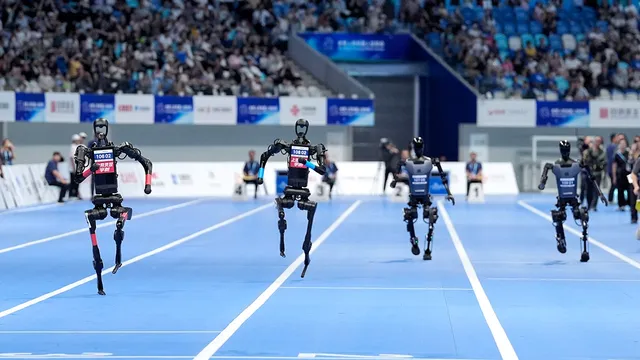
Bolt outruns human at 22 mph in groundbreaking robot test
Bolt outruns human at 22 mph in groundbreaking robot test
- MirrorMe Technology unveiled Bolt, a humanoid robot that achieved a top speed of 22 mph during testing.
- The robot's design includes advanced balance control, allowing it to maintain speed while running.
- Bolt's speed highlights the potential for humanoid robots to assist in athletic training, raising safety and regulatory concerns.
Story
In a significant advancement in robotics, the Chinese firm MirrorMe Technology showcased its latest creation, a humanoid robot named Bolt, which achieved a remarkable speed of 22 miles per hour during testing. This notable event took place in a controlled facility designed to allow for such high-speed maneuvers safely. The footage of Bolt's sprint was shared on the social media platform X, demonstrating how the robot can efficiently navigate at such a high velocity, setting a new benchmark for humanoid robots of its size. The founder of MirrorMe Technology, Wang Hongtao, participated in a side-by-side comparison with Bolt, where he ran on a treadmill, providing a clear visual of the speed differential between human and machine. The technological achievement of Bolt’s speed lies in its advanced balance control, which allows it to maintain stability while running. Unlike a human, Bolt employs shorter strides coupled with a rapid stride rhythm, enabling it to cover significant ground quickly. While the swift pace grabs attention, MirrorMe Technology emphasizes that the primary goal is not merely to outrun humans. Instead, the firm aims to harness Bolt's capabilities for more practical applications, including aiding runners with precise motion data for form and endurance improvements. As humanoid robots like Bolt start demonstrating capabilities that can match or exceed human motion, the implications of such technology extend beyond the racing track. Concerns about safety and regulations surrounding the operation of high-speed robots in populated areas are becoming increasingly relevant. The conversation must shift towards establishing guidelines that can ensure the safe integration of such robots in various environments. The rapid development of robots like Bolt demonstrates the need for clear limits and oversight while exploring their benefits in training and athletic performance. Moving forward, the success of Bolt not only highlights the strides made in robotics but also suggests a future where humanoid machines could play an integral role in athletic training, personal coaching, or even medical rehabilitation. The ongoing challenges posed by their capabilities and the cautious approach needed toward their implementation in society are crucial for balancing innovation and public safety. As these technologies continue to evolve, discussions around best practices and regulatory frameworks will be essential to harness their potential effectively.


