

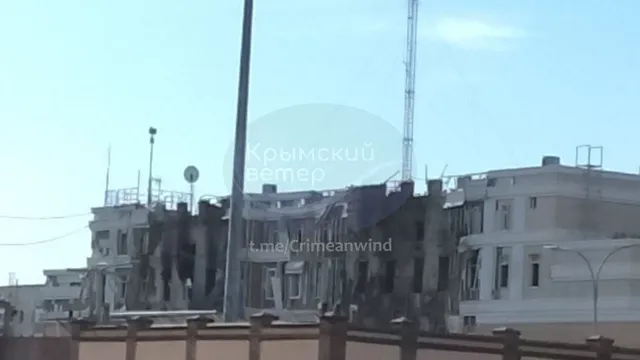
Ukrainian drone strike devastates FSB facility in occupied Crimea
Ukrainian drone strike devastates FSB facility in occupied Crimea
- Ukrainian drone strikes targeted an FSB facility in Armyansk, Crimea, leading to significant destruction.
- Reports indicated that half of the building was completely destroyed, with extensive damage observed on-site.
- This attack marks an escalation in Ukraine's military efforts against Russian-occupied territories.
Story
On May 5, Ukrainian drones targeted a Russian Federal Security Service (FSB) complex located in the city of Armyansk, Crimea. This event occurred as tensions escalated due to the ongoing conflict in the region between Ukraine and Russia. Reports indicate that the drone strikes happened around 9 p.m. local time and were characterized by a series of explosions that caused extensive damage to the facility. Video footage shared on social media platforms showcased the destructive aftermath of the strike, revealing fire, smoke, and structural devastation, particularly to the FSB border guard service headquarters. The Russian-installed official of Crimea, Sergey Aksyonov, publicly acknowledged the drone attack during a statement made shortly after the explosions, confirming that air defense systems and mobile fire teams had been activated in response to the attack. Local witnesses reported seeing a glow over the city and detected a burning odor resulting from the strikes. As the news circulated, the pro-Ukrainian Telegram channel, Crimean Wind, provided detailed reports indicating that half of the FSB building had been completely destroyed, emphasizing the severity of the incident. This attack is part of a broader wave of recent hostilities, as Ukraine has increased military actions aimed at Russian-occupied territories. The Ukrainian government has not officially claimed responsibility for this particular strike, but the timing coincided with increased tensions surrounding the conflict. Previous hostilities in Armyansk involved Ukrainian forces targeting military infrastructures, including an earlier incident in August 2025 that resulted in significant damage to an FSB outpost. The ongoing military engagement continues to result in mounting civilian casualties, with previous reports indicating numerous violations of ceasefire agreements by Russian forces. In public statements, Aksyonov urged residents to remain calm and rely solely on official information sources amid the crisis. This serves as a reminder of the widespread anxieties regarding potential repercussions and escalations in military actions in the region, particularly with the marking of the upcoming Victory Day celebrations in Russia, during which tensions often surmount due to heightened nationalist sentiments. International observers are closely monitoring the situation as it unfolds, anticipating potential retaliatory measures and their implications for the broader conflict.
Context
The current situation in Crimea remains tense and complex, primarily due to the ongoing Ukrainian-Russian conflict, which escalated in 2014 when Russia annexed Crimea. This event has not only transformed the geopolitical landscape of Eastern Europe but has also led to significant human rights concerns in the region. Citizens of Crimea now face a precarious situation under Russian rule, which is characterized by restrictions on freedom of expression, assembly, and other fundamental liberties. The Ukrainian government and various human rights organizations continue to report systematic oppression of the Crimean Tatar population, who have been increasingly targeted for their opposition to the annexation and who face discriminatory practices in education, employment, and various facets of public life. Economically, Crimea has suffered immensely since the annexation. The integration of the peninsula into the Russian economy has generated mixed results, with significant investments from the Russian Federation aimed at infrastructure development. However, these efforts have yet to create substantial improvements in the living standards of the local population. Tourism, once a vital part of Crimea's economy, has declined sharply, partially due to international sanctions against Russia and a decrease in visitors from Ukraine and the West. Many businesses face challenges in adapting to the new economic reality under Russian governance, and unemployment rates have risen as local industries struggle to survive. The international community remains divided over the status of Crimea. While countries in the West, including the United States and European Union members, have imposed sanctions on Russia and continually affirm Ukraine's territorial integrity, some nations have either recognized the annexation or have chosen to remain neutral. This divide complicates diplomatic efforts aimed at resolving the conflict, as Russia continues to assert its claims over Crimea, citing historical ties and the results of a disputed referendum held shortly after the annexation. Peace talks have been sporadic and largely ineffective, with a resolution to the conflict appearing distant as of now. Furthermore, the military presence in Crimea has intensified, with Russia reinforcing its military capabilities on the peninsula. This has raised security concerns among neighboring nations, particularly Ukraine, who view these developments as potential threats to their sovereignty and stability. The ongoing military maneuvers and exercises have led to increased tensions in the Black Sea region, further complicating the situation. As of May 2026, the geopolitical climate surrounding Crimea remains precarious, characterized by an enduring conflict that has far-reaching implications for regional security and international relations.


