

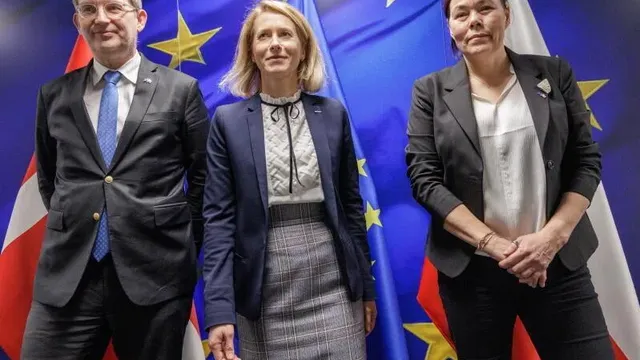
Denmark ramps up military presence in Greenland amid Trump's acquisition demands
Denmark ramps up military presence in Greenland amid Trump's acquisition demands
- Denmark has sent additional troops to Greenland in response to U.S. President Donald Trump's proposal to acquire the island.
- The Danish government has reaffirmed its rejection of Trump's overtures, citing strong support from European allies.
- This situation underscores heightened tensions in the Arctic regarding sovereignty and national security.
Story
Denmark has taken significant steps to bolster its military presence in Greenland due to escalating tensions arising from U.S. President Donald Trump's persistent desire to acquire the self-governing Arctic territory. In a recent development, the Danish government has rejected Trump's proposal to purchase Greenland, which he has cited as vital for national security, claiming it is crucial to counter the influence of Russia and China in the Arctic region. This assertion has led to a strong response from European Union member states, who are united in their support of Denmark's sovereignty over Greenland. In light of Trump’s threats of tariffs on various European nations, including Denmark, to pressure them into negotiating the sale of Greenland, Denmark has sent additional troops to the island. Major General Soren Andersen, commander of Denmark's Joint Arctic Command, confirmed the deployment of approximately 200 soldiers, strategically positioned in key locations such as Nuuk and Kangerlussuaq. This military buildup is part of a larger exercise known as Arctic Endurance, designed to reinforce Denmark’s defense capabilities in the area and demonstrate its commitment to protecting its territorial integrity. Furthermore, discussions involving Denmark, Greenland, and NATO have prompted considerations for a formal NATO mission in the Arctic, aimed at providing additional security assurances against perceived threats posed by Russia and China. Danish Defence Minister Troels Lund Poulsen has expressed optimism about the possibility of establishing a framework for NATO involvement, as these discussions unfold against the backdrop of the heightened tensions stemming from Trump's rhetoric regarding Greenland's sovereignty. The U.S. has continued to position aircraft from the North American Aerospace Defense Command (NORAD) at Pituffik Space Base in Greenland, underscoring its ongoing military interest in the Arctic. NORAD has stated that these activities were pre-planned and coordinated with Denmark, which reflects a complicated relationship between the two countries amid Trump’s controversial aspirations to control Greenland. European politicians have condemned Trump's tactics, viewing them as undermining transatlantic relations, and some have warned that an aggressive pursuit of Greenland could destabilize NATO alliance dynamics, with serious implications for global security. In summary, the ongoing military movements and discussions highlight a significant moment in the geopolitical landscape of the Arctic, where alliances and territorial sovereignty are being challenged. The situation continues to evolve as Denmark remains steadfast against selling Greenland, emphasizing that its status as an autonomous territory is non-negotiable, while NATO allies are rallying to support Denmark in these uncertain times.
Context
The current geopolitical situation in the Arctic is characterized by a complex interplay of territorial claims, environmental concerns, and the strategic interests of various nations. As climate change continues to impact the region, melting ice is opening up new shipping routes and access to untapped natural resources, leading to increased interest from Arctic and non-Arctic states alike. The potential for energy extraction, particularly oil and gas, has prompted a race among nations to assert their sovereignty over parts of the continental shelf and are often underscored by historical treaties, such as the United Nations Convention on the Law of the Sea (UNCLOS). However, the challenge lies in balancing economic opportunities with environmental responsibilities, as increased activity poses significant risks to fragile Arctic ecosystems and indigenous communities who rely on these environments for their livelihoods. The Arctic Council, comprising eight member states—Canada, Denmark (Greenland), Finland, Iceland, Norway, Russia, Sweden, and the United States—plays a crucial role in promoting cooperation on issues related to sustainable development and environmental protection in the region. Despite the geopolitical tensions, especially between Russia and Western nations, there are ongoing dialogues and collaborative efforts to address climate change impacts and uphold the rights of Arctic indigenous peoples. However, the military presence has been a growing concern; Russia has been actively enhancing its military infrastructure in the Arctic, prompting NATO and other member countries to bolster their presence in response. This has led to an uptick in military exercises, raising fears of escalation in a region that has historically been characterized by cooperative governance. Moreover, non-Arctic nations, particularly China, have shown increasing interest in the Arctic, positioning itself as a near-Arctic state and actively seeking partnerships for infrastructure development, particularly in shipping and natural resource management. China's 'Polar Silk Road' initiative underlines its ambition to connect its economic sphere with Arctic shipping routes, enhancing its influence but also raising alarms among Arctic nations about security and environmental implications. The strategic value of the Arctic is expected to increase as global economic dynamics shift towards energy security and resource availability in light of geopolitical tensions elsewhere in the world. In conclusion, the Arctic is at a pivotal moment regarding its geopolitical situation. Nations must navigate the complicated dynamics of competing territorial interests, environmental stewardship, and the rights of indigenous communities. Maintaining the Arctic as a zone of cooperation rather than conflict requires ongoing diplomatic engagement and a commitment to shared governance, emphasizing sustainability and conflict resolution. As the effects of climate change continue to unfold, stakeholder collaboration and mutual respect among Arctic and non-Arctic states will be essential to ensure that the region remains a peaceful environment for future generations.


