
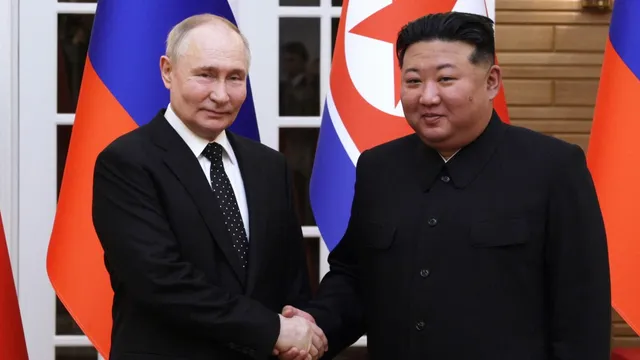
Kim Jong Un vows unwavering support for Russia amidst Ukraine conflict
- Kim Jong Un held a memorial ceremony in Pyongyang for North Korean soldiers who died fighting in Ukraine.
- He emphasized continued military cooperation with Russia, discussing a long-term five-year plan.
- This alliance suggests that North Korea will maintain its support for Russia beyond the Ukraine conflict.
Story
In Pyongyang, North Korea, on an unspecified date prior to April 27, 2026, Kim Jong Un reaffirmed his country's support for Russia during a memorial event for North Korean soldiers who died in the Ukraine war. The memorial, honoring North Korean troops who fought alongside Russian forces in the Kursk region, was unveiled in the presence of Russian Defense Minister Andrey Belousov. This ceremony highlighted the increasing military collaboration and long-term partnerships between the two countries as they navigate their geopolitical challenges. Analysts noted that this cooperation is likely to be sustained even beyond the ongoing Ukraine war. The inclusion of military ties is a critical factor in North Korea's approach to international politics. Kim's remarks during the event indicated a commitment to bolster military cooperation with Russia and a broader strategic partnership that was solidified with the 2024 Comprehensive Strategic Partnership Treaty. This treaty, which includes a mutual defense provision, marked a significant deepening of ties, suggesting that North Korea aims to solidify its position as an ally of Russia amid increasing tensions with the West. The commemorative ceremony was also marked by symbolic gestures such as a concert dedicated to fallen soldiers, an indication of how North Korea seeks to publicly honor those who have died fighting for Russia. The state media reported that Kim expressed pride in North Korean troops and their role in thwarting what he described as the hegemonic ambitions of the United States and its allies. Moreover, the North Korean leader discussed the need for continued development of military and political cooperation, suggesting a long-term alignment of interests between North Korea and Russia. Furthermore, there are indications that North Korea has significantly benefited from this alliance, having received economic and military technology assistance in exchange for its support in the Ukraine conflict. Estimates suggest that tens of thousands of North Korean soldiers have been deployed to assist Russian forces, and while the human cost has been high with thousands reported dead, the leadership in Pyongyang continues to frame this cooperation as part of a larger struggle against perceived Western imperialism, thus further entrenching their alliance amid global geopolitical shifts.
Context
The ongoing war in Ukraine has had significant implications for the geopolitical landscape, particularly in relation to the dynamics between North Korea and Russia. As the conflict unfolded, it has become increasingly clear that the relationship between Pyongyang and Moscow is influenced by Russia's strategic objectives in Eastern Europe and North Korea's aspirations within its own regional context. The war has prompted Russia to seek alliances that enhance its position against Western sanctions and military pressures, thereby creating a potentially favorable environment for North Korea to strengthen its ties with Russia, particularly in areas of military collaboration and economic support. In the wake of the conflict, North Korea has displayed a keen interest in aligning more closely with Russia, partly influenced by its desire to receive economic aid in exchange for diplomatic support. Russia's ongoing engagement in the war has led to a strain in its relationships with Western nations, compelling it to rely on partnerships with states traditionally at odds with Western powers, including North Korea. This evolving relationship is evident in recent communications, joint military exercises, and discussions centered around arms provisions, which have been heightened in the context of the perceived need to counteract U.S. influence in the region. The situation underscores a mutual desire to bolster each other's strategic positioning amid escalating geopolitical tensions. Furthermore, the war in Ukraine has also affected North Korea's military posture and strategic calculations. As Western nations support Ukraine with military and financial resources, North Korea appears emboldened to pursue its own military objectives more aggressively, likely viewing the conflict as an opportunity to enhance its bargaining power both regionally and internationally. The potential for increased military cooperation with Russia may embolden North Korea to advance its missile tests and provoke further tensions in the Korean Peninsula, which could have severe implications for regional security dynamics. Ultimately, the impact of the Ukraine war on North Korea-Russia relations reflects a convergence of interests driven by shared goals of minimizing Western influence and fortifying their respective security frameworks. As both countries navigate the complexities of the current international landscape, their partnership may deepen, bringing with it both opportunities and challenges not only for their nations but also for global stability. The implications of this evolving relationship are critical to understand, especially as it may influence future geopolitical shifts and the stability of the Korean Peninsula amidst ongoing tensions linked to the Ukraine conflict.
