

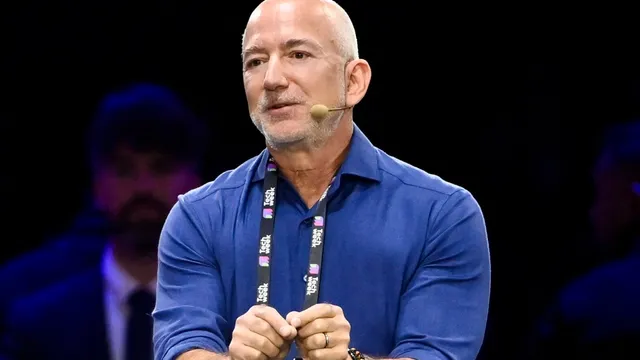
Jeff Bezos refutes claim about McDonald's job advice to entrepreneurs
Jeff Bezos refutes claim about McDonald's job advice to entrepreneurs
- Jeff Bezos denied a claim that he advised young entrepreneurs to start at McDonald's.
- Polymarket, the source of the claim, has faced previous misinformation accusations.
- Bezos's denial highlights concerns regarding the integrity of information shared on prediction market platforms.
Story
In a recent occurrence, billionaire Jeff Bezos publicly denounced claims made on social media suggesting that he recommended aspiring young entrepreneurs start their careers at fast-food chains like McDonald's or at tech companies like Palantir. This claim originated from a post by Polymarket, a prediction market platform, which posted the advice on its social media account with a substantial following on the platform known as X. Following the blast of activity around this post, Bezos promptly replied to it, stating simply, "Nope," indicating his clear disapproval of the fabricated information circulating about him. Polymarket's assertion stirred up discussions about the credibility and integrity of information being shared through its platform. This incident isn’t an isolated one; the platform has faced previous accusations concerning the propagation of misinformation on social media. Given its business model, which heavily relies on prediction market prices reflecting wagers on real-world outcomes, there arises a significant concern regarding how false claims can distort trading behaviors and affect perceived probabilities within the marketplace. The reaction to Bezos’s swift rebuttal can also be seen as an indication of greater scrutiny being placed on Polymarket and its practice of sharing unverified news. Despite this, Bezos had previously provided insights during an interview at Italian Tech Week in October of last year, where he offered genuine advice to young entrepreneurs, advocating for real-world job experiences before embarking on their entrepreneurial journeys. He encouraged gaining valuable experience in well-established companies to enhance their chances of success while emphasizing his own experience of launching Amazon at the age of 30 instead of 20, suggesting that the additional ten years provided essential knowledge and tools that contributed to Amazon's success. The blending of anecdotes regarding entrepreneurship from successful figures in tech, such as Bill Gates and Mark Zuckerberg, could easily be misinterpreted when subjected to misleading contexts. As the incident continues to unfold, Bezos's public denial remains relevant, raising questions about the overall reliability of content shared by prominent platforms like Polymarket that may impact not just individual perceptions but also the stocks or businesses of young entrepreneurs looking to forge their paths in the business world. The fallout from this interaction may compel both users and creators of content to discern information more carefully in the fast-evolving digital landscape, which is often rife with sensational or dubious claims under the guise of discourse.


