

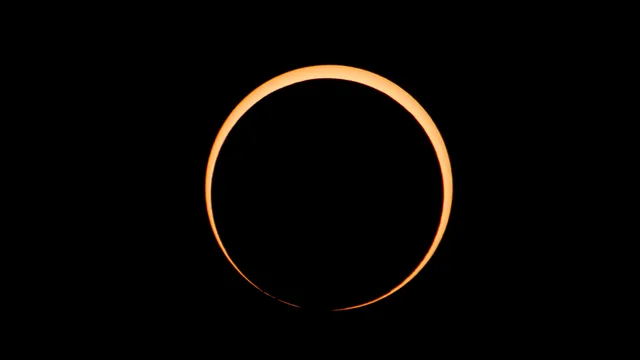
Eclipse offers rare sights as 'ring of fire' appears in Antarctica
Eclipse offers rare sights as 'ring of fire' appears in Antarctica
- An annular solar eclipse takes place today, February 17, 2026, featuring a rare 'ring of fire'.
- The full eclipse will be exclusively observed in parts of Antarctica, with others experiencing a partial view.
- This phenomenon presents a unique opportunity for researchers and sky watchers, contributing to ongoing interest in astronomy.
Story
Today, February 17, 2026, an annular solar eclipse is occurring, where the moon is positioned between the Earth and the sun. This cosmic event is particularly remarkable as it takes place when the moon is at or near its apogee, making it appear smaller and allowing the sun's light to form a 'ring of fire' around the moon. The full annular eclipse can be observed exclusively from parts of Antarctica, while others located within the path will see a partial eclipse. The event's peak will occur at 11:45 UTC (6:45 AM EST), gradually decreasing in visibility throughout the day. While Antarctica doesn't have permanent residents, some researchers and workers on the continent will have the unique opportunity to witness the eclipse in its entirety. As the celestial bodies align, those watching from Antarctica will experience the awe-inspiring sight of the 'ring of fire' phenomenon, an effect that occurs specifically during this kind of eclipse. Astronomers, like Joe Llama from Lowell Observatory, humorously noted that even the 'penguins' in Antarctica would be lucky enough to see this spectacle. In stark contrast, individuals located outside of Antarctica will experience a partial eclipse, meaning that the moon won't perfectly cover the sun. For those in parts of southern Africa and South America, including Argentina and Chile, the eclipse will be less dramatic - it will instead appear that the moon has taken a bite out of the sun. According to predictions, during its maximum coverage, the sun will be obscured by almost 96%, decreasing to 80% as time progresses, and finally to just 10%. The tips of regions like Chile and Argentina, as well as Madagascar and Lesotho in southeastern Africa, are expected to have the best views of this partial eclipse, providing weather permitting conditions for optimal viewing. As significant astronomical events, solar eclipses serve as reminders of the intricate movements of celestial bodies. All eyes will be peeled towards the skies today as to catch glimpses of the stunning eclipse phenomena, especially in the unique environment of Antarctica. The scientific community expects high levels of interest and observation for this rarity, pushing excitement among sky watchers and astronomers alike. This is not just an extraordinary cosmic event but also a wonderful excuse for observational astronomy and studies related to eclipse effects, providing significant data for future reference.


