

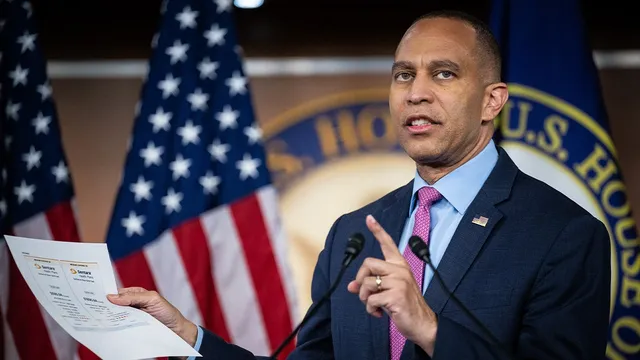
Jeffries feels excluded from Trump-Schumer funding agreement
Jeffries feels excluded from Trump-Schumer funding agreement
- A group of Senate Republicans, led by Senator Roger Marshall, critiqued House Minority Leader Hakeem Jeffries for feeling excluded from a significant government funding deal.
- The House had passed a funding package while most House Democrats opposed it, partly due to concerns over the Department of Homeland Security.
- Despite initial tensions, leaders Chuck Schumer and Hakeem Jeffries worked together to present reform demands, showcasing a potential return to unity among Democrats.
Story
In the United States, on a Wednesday, February 2, 2026, a Senate Republican accused House Minority Leader Hakeem Jeffries of being emotionally hurt after he was not included in a deal between Senate Minority Leader Chuck Schumer and President Donald Trump regarding government funding. The House passed a five-bill funding package, along with a two-week extension for the Department of Homeland Security (DHS). Jeffries, alongside most House Democrats, voted against the bill. Senator Roger Marshall claimed that Jeffries was upset because he was not contacted during the negotiations that aimed to alleviate the ongoing partial government shutdown. The Senate deal primarily funded 11 out of the 12 federal agencies, leaving the Department of Homeland Security unresolved. Following a tragic incident where an individual was fatally shot during an immigration operation, Senate Democrats demanded that the bipartisan funding bill be re-evaluated to include stricter regulations for Immigration and Customs Enforcement (ICE). Marshall asserted that the negotiations took place without Jeffries because Schumer finalized the deal without consulting him, thereby further complicating the relationship between the Senate and House Democrats. This situation placed pressure on Schumer to reinstate a unified front with Jeffries. Despite the initial discord, Schumer and Jeffries publicly announced that they had reconciled and collaboratively endorsed a new list of demands concerning reforms for DHS and ICE. Among these demands, they called for increased oversight and measures to limit roving patrols, which have sparked significant concern among various demographic groups. The Democrats emphasized their desire to represent constituents' interests in shaping a more effective funding bill. Schumer noted that the framework for negotiations would be shared with Republicans shortly, indicating a shift towards bipartisan collaboration in light of new demands. The developments signal a precarious balance in negotiations ahead of a critical funding decision. Although the short-term deal had averted a complete shutdown, many in the Senate remained skeptical about the sincerity of Democrats in negotiating with Republicans because of the previous abandonment of a bipartisan deal. Jeffries expressed hope that new proposals would address vital changes needed at DHS before a full-year appropriations bill could be pursued. The tension regarding these negotiations encapsulates the ongoing struggle among Democrats in their efforts to maintain cohesion while addressing sharp partisan divisions within Congress.


