

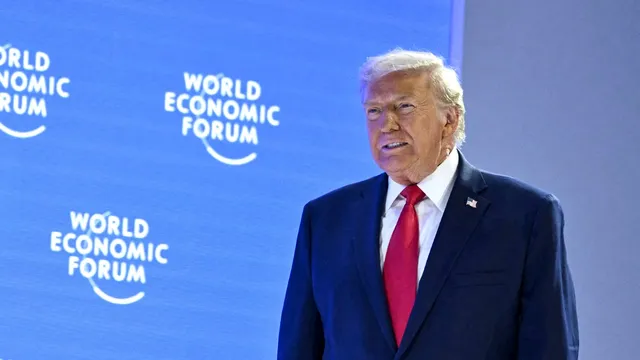
Trump rules out force but insists on acquiring Greenland
Trump rules out force but insists on acquiring Greenland
- During a speech at the World Economic Forum in Davos, Switzerland, President Trump stated he would not use military force to acquire Greenland.
- He emphasized the importance of the U.S. controlling Greenland for security reasons, while criticizing Denmark for returning it after WWII.
- Trump's speech raised concerns among international leaders but highlighted ongoing discussions about the future of Greenland.
Story
On January 21, 2026, at the World Economic Forum in Davos, Switzerland, U.S. President Donald Trump addressed international leaders regarding the long-standing issue of Greenland, an autonomous territory of Denmark. During his speech, he made it clear that he would not resort to military force for a possible acquisition, despite previous comments implying a more aggressive stance. Trump’s rhetoric emphasized the need for the U.S. to control Greenland for security reasons, particularly due to missile threats, underscoring his belief that Europe and other nations cannot adequately secure the territory. Trump referred to his vision of a future agreement that would see Greenland under U.S. control, while acknowledging Denmark’s sovereignty. He mentioned past U.S. military occupation of the island during WWII as a basis for reclaiming ownership. Notably, he criticized Denmark, claiming it was ungrateful for the U.S. having returned Greenland after defeating the Axis powers. The reaction from the international audience was mixed, with some relieved by his assertion of no military action, while others expressed concern over the implications of his desire to expand U.S. influence in such a critical region. The statement came after weeks of tension, including Trump's threats to impose tariffs on European nations that supported Denmark's claim over Greenland. In light of recent geopolitical dynamics and the growing presence of Russia and China in the Arctic, U.S. officials have indicated that negotiations will continue to ensure NATO allies can secure Greenland without falling under foreign influence. Trump's comments seemed to indicate that he is more interested in establishing a stronger negotiating position, rather than pushing for outright annexation at all costs, with discussions centered on ensuring security and resource access.
Context
Greenland's historical significance under Denmark is shaped by various phases of colonialism, strategic geopolitics, and indigenous culture. From its colonization in the early 18th century, marked by the establishment of trading posts by Danish-Norwegian explorers, to its transition into a territory of Denmark, Greenland's status has evolved. Initially regarded as a remote and inhospitable land, its value was primarily economic, with natural resources such as fish and minerals slowly coming to the forefront. Denmark's administration sought to integrate Greenland into its trade network, leading to a mix of cultural exchanges yet also impositions on local ways of life. This early colonial period set the stage for a complicated relationship defined by economic dependency and cultural imposition. The geopolitical importance of Greenland escalated notably during the Cold War. The island's location between North America and Europe became crucial for military strategy, with the establishment of U.S. bases and surveillance systems amid rising tensions between superpowers. Greenland's status as an integral part of the Kingdom of Denmark allowed Denmark to maintain a strategic foothold in Arctic geopolitics. This period highlighted how Greenland's status under Denmark was not merely a result of its geographic characteristics but also a reflection of global political dynamics, introducing complexities into the drive for autonomy and self-determination among Greenlandic people. In the later part of the 20th century, movements for greater self-governance gained momentum, culminating in the 2009 Self-Government Act. This legislation provided Greenland with increased autonomy, allowing greater control over domestic affairs while Denmark retained authority over foreign policy and defense, representing a significant shift in the historical narrative. This development indicated acknowledgment of the rights of the indigenous Inuit population and their desire for self-determination. As Greenland negotiates its identity and future relationship with Denmark, the discussions center around issues such as resource management, economic development, and climate change, which are increasingly relevant due to the effects of global warming on the Arctic region. Today, the significance of Greenland's status under Denmark lies in its interplay between colonial history and contemporary aspirations for self-governance. The ongoing dialogue about possible independence or enhanced autonomy reflects the challenges faced by post-colonial societies in balancing historical legacies with modern ambitions. As Greenland seeks to carve out its future, its relationship with Denmark remains critical, inviting reflections on sovereignty, identity, and the impacts of historical actions on present and future generations. The historical context of this relationship offers valuable insights into how colonial narratives continue to shape political discussions and national identities in the Arctic.


