
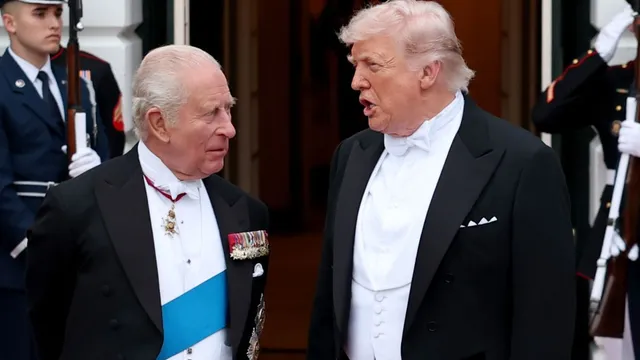
Trump criticizes NATO after King Charles backs alliance
- King Charles III delivered a significant speech on NATO and U.S.-U.K. relations during his state visit.
- Donald Trump expressed disappointment with NATO, contradicting the king's supportive statements.
- The incident highlights the delicate balance of political discourse and royal protocols, with potential implications for future relations.
Story
During a state visit to the United States, King Charles III and Queen Camilla were engaged in various diplomatic activities on their third day in New York City. King Charles delivered a significant speech to Congress, where he underscored the importance of the special relationship between the U.S. and the U.K., as well as the relevance of NATO. However, shortly afterward, U.S. President Donald Trump conveyed his disappointment with NATO, contradicting the monarch's supportive sentiments. Trump also hinted at a more aggressive stance regarding Iran, suggesting that had King Charles had his way, he might have supported U.S. military actions against Iran. The conversations held at a state dinner were particularly revealing. Trump commented that he believed King Charles shared his views on preventing Iran from acquiring nuclear weaponry. Trump's ambiguous phrasing left implications about whether he was suggesting an imminent military action against Iran based on the king's perspective. This echoes historical sensitivities around British foreign policy, particularly relating to situations such as the Suez Crisis, which marked a pivotal moment in British politics. While the king's visit was typically ceremonial, it is crucial to note that British royals are expected to remain aloof from political matters, making Trump's remarks a delicate issue. A Buckingham Palace spokesperson reiterated the King's commitment to his government’s stance on nuclear non-proliferation and the necessity of avoiding any direct involvement in political discourse. This incident raises further questions about acceptable political boundaries for royals, especially during significant state visits. Overall, the interactions at the state dinner and the king's speech could have far-reaching implications on transatlantic relations, especially concerning Iran and NATO's role in security policies. The atmosphere surrounding the discussions suggests a need for diplomatic care, considering how perceptions can be easily shaped by such public comments made by a sitting U.S. president and the royal family.
Context
NATO, the North Atlantic Treaty Organization, has played a crucial role in transatlantic security since its establishment in 1949. The alliance was formed to provide collective defense against potential adversaries, with a focus on the Soviet Union during the Cold War. Over the decades, the relationship between NATO and its key members, particularly the United States and the United Kingdom, has significantly shaped the alliance's policies and operations. As global security threats evolve, the dynamics of this relationship continue to adapt in response to new challenges, including terrorism, cyber threats, and the rising influence of countries such as China and Russia. The United States has historically been the most influential member of NATO, providing substantial military capabilities and financial resources. The U.S. commitment to NATO is governed by Article 5 of the Washington Treaty, which states that an armed attack against one or more members is considered an attack against all. This principle has been invoked only once, in response to the September 11 attacks in 2001. The U.S. has also led numerous NATO missions, demonstrating its commitment to collective defense and burden-sharing. However, recent years have seen discussions about the need for fairer sharing of defense costs, with President Biden emphasizing the importance of all NATO members meeting their defense spending targets. The United Kingdom, as one of NATO's founding members, holds a pivotal role within the alliance. The UK is a key military power in Europe and has participated in many NATO operations, enhancing the alliance's capabilities. British contributions range from strategic nuclear deterrence to ground forces deployed in various global conflicts. The UK's departure from the European Union in 2020 raised questions about its future role in European security; however, it remains committed to NATO and continues to bolster its defense ties with the U.S. and other member countries. The AUKUS security pact involving Australia, the U.K., and the U.S. highlights the ongoing commitment to transnational security collaboration beyond NATO's traditional framework. Looking ahead, NATO's relationship with the U.S. and the U.K. will be crucial in addressing the changing landscape of global security. The alliance is increasing its focus on emerging threats, including cyber warfare and disinformation campaigns, while also reaffirming its stance against potential aggressors like Russia, especially following events such as the annexation of Crimea in 2014 and the ongoing conflict in Ukraine. The need for unity among member states is essential to navigate these evolving threats and maintain the credibility of the collective defense principle. As NATO continues to adapt, the cooperation between the U.S. and the U.K. remains vital to preserve the stability and security of the transatlantic region.
