

Guard members awarded Purple Heart after DC ambush shooting
Guard members awarded Purple Heart after DC ambush shooting
- Two West Virginia National Guard members were attacked in Washington, D.C., resulting in one fatality and one serious injury.
- The attacker, Rahmanullah Lakanwal, previously worked with the CIA and has pleaded not guilty to multiple charges.
- The awarding of the Purple Heart to the wounded service members highlights the ongoing discussion about domestic attacks against military personnel.
Story
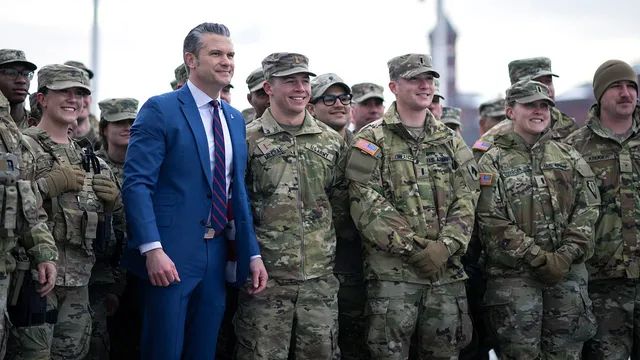
In November 2025, two members of the West Virginia National Guard were shot in Washington, D.C., during an ambush-style attack near the White House. The incident resulted in the tragic death of Army Specialist Sarah Beckstrom, who succumbed to her injuries on November 26, a day before Thanksgiving. Air Force Staff Sergeant Andrew Wolfe sustained serious injuries, including a gunshot wound to the head, and is currently in recovery, with scheduled skull reconstruction surgery. The suspect in this shooting, Rahmanullah Lakanwal, a 29-year-old Afghan national, was previously associated with the CIA in Afghanistan. He was arraigned on nine charges, among them first-degree murder and assault with intent to kill. Prosecutors have indicated that they are considering additional charges that could position Lakanwal for the death penalty. He has pleaded not guilty to all counts. This event marks one of the rare instances on American soil where personnel have been awarded the Purple Heart, typically associated with injuries or fatalities sustained in combat. The shooting has raised significant discussions regarding eligibility for the Purple Heart award, as it is usually reserved for incidents involving identified enemy combatants in war zones. Previous incidents, such as the 2015 Chattanooga shootings, have caused bureaucratic reviews of similar scenarios. The Trump administration labeled Lakanwal a terrorist, although concrete evidence tying him to an organized terrorist group remains undisclosed. Lakanwal made an asylum application that was approved in 2025 after being among the thousands of Afghans evacuated following the Taliban's takeover earlier that year. West Virginia's Governor Patrick Morrisey expressed that the awarding of the Purple Heart honors the troops' service and provides reassurance to their families. Hegseth formally announced the awards during a National Guard reenlistment ceremony at the Washington Monument, recognizing the ongoing commitment of Guardsmen serving in the targeted mission in D.C. This incident underscores the risks that military personnel continue to face, not only overseas but in domestic terrains as well, highlighting the importance of national security and the impact of violence in America today.
Context
The Purple Heart is one of the United States' oldest military decorations, established by General George Washington in 1782. Originally known as the "Badge of Military Merit," it was awarded to honor soldiers who displayed exceptional valor during the American Revolutionary War. The badge featured a heart-shaped purple cloth, embroidered with white thread, and was a symbol of courage and sacrifice. However, after the Revolutionary War, the award fell into obscurity until it was resurrected in 1932 as the now-familiar medal, during the 200th anniversary of Washington's birth. This revitalization aimed to create a prestigious decoration for those wounded or killed while serving in the United States military, reaffirming Washington's original intent to incentivize valor and recognize suffering endured in service to the nation. The Purple Heart is unique among military medals as it is specifically awarded to those who have been wounded or killed as a direct result of enemy action. The criteria for the award have evolved over time, but the essential principle remains the same: it is a symbol of the sacrifice made by service members in defense of the United States. Each recipient of the Purple Heart is recognized for their individual act of bravery and the personal cost associated with military service. Over the decades, the medal has been awarded to millions of service members from various conflicts, including World War I, World War II, the Korean War, the Vietnam War, the Gulf War, and contemporary operations in Iraq and Afghanistan. In its current form, the Purple Heart is a medal that features a depiction of George Washington on horseback in the center, surrounded by a purple heart-shaped frame. It also includes a ribbon bordered in white. The award is often presented in a formal ceremony or given posthumously to the families of fallen service members. The medal not only serves as a token of honor but also symbolizes the resilience and strength of those who have endured the physical and emotional scars of war. Furthermore, recipients often become part of a larger community of veterans who share similar experiences and stories. Throughout its history, the Purple Heart has adapted to changing military practices and societal attitudes toward wartime service and sacrifice. In recent years, there has been a push to ensure that all eligible service members are recognized for their sacrifices, leading to a broader acknowledgment of those who serve in various capacities. The medal continues to be a respected symbol of sacrifice and bravery, representing both the individual and collective experiences of American servicemen and women. As the nation moves forward, honoring the legacy and sacrifices represented by the Purple Heart remains a vital part of expressing gratitude to those who have served and those who have suffered in defense of freedom.


